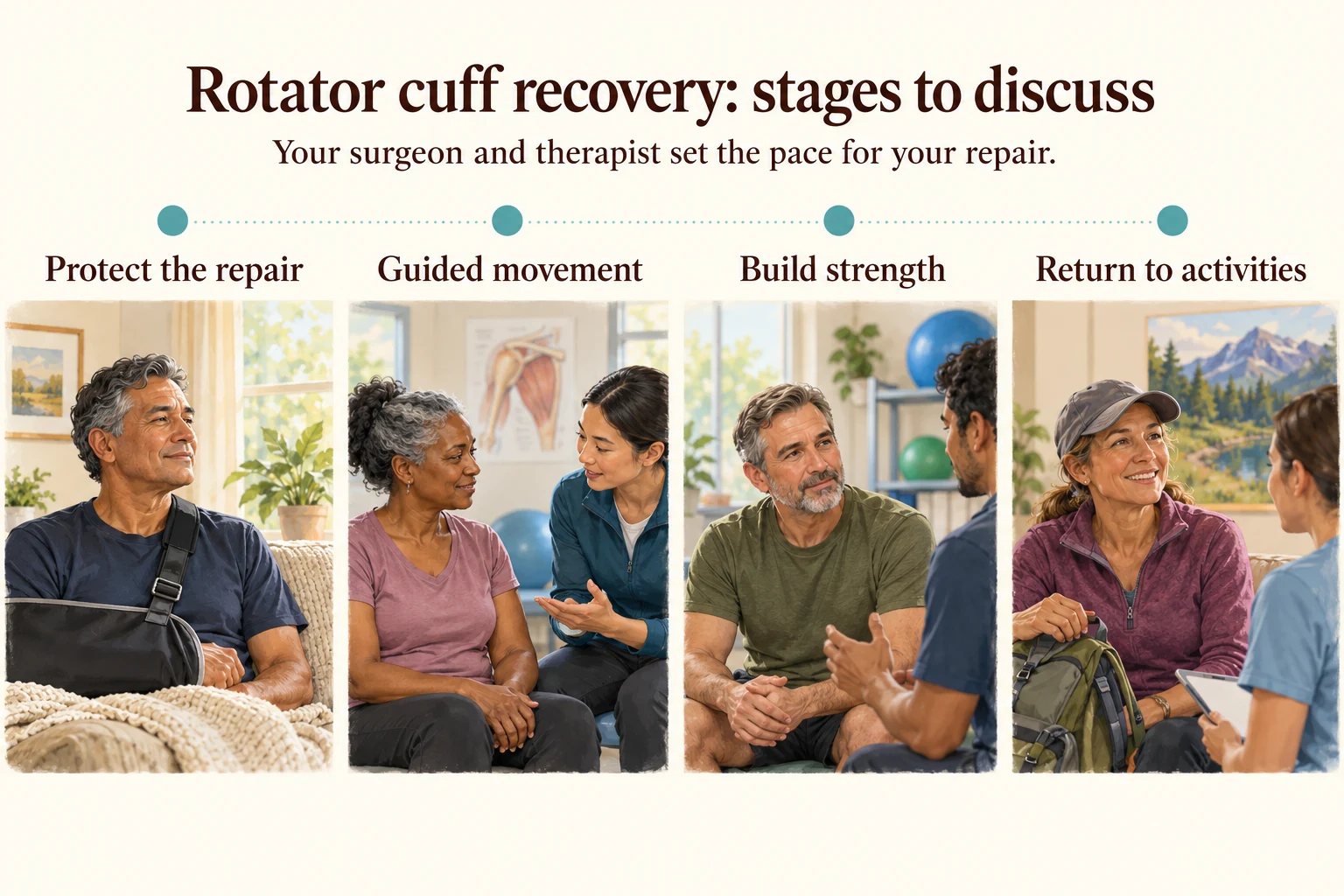
Original educational illustration. Illustrated scenes show protecting a repair, guided movement, strength planning and return-to-activity discussion.
Your surgeon and therapist set the pace for the particular repair. The sequence does not prescribe exercises, weights or dates. The people shown are fictional illustrations.
Illustration references: Reference 1 · Reference 2

Original educational illustration. An illustrated living area shows a clear walking path, firm chair, nearby phone, water and written plan.
Arrange meals, transport and check-ins. Keep essentials within reach and agree on a contact and medication plan. The room is an illustration; a discharge assessment must consider your own mobility, restrictions and available support.
Illustration references: Reference 1 · Reference 2
1. Dressing and personal care
Ask which arm movements are permitted and whether the team can demonstrate dressing with your sling or other restrictions. Set out clothing that is manageable without forcing the shoulder. Discuss bathing, washing hair and toileting openly; these are normal preparation questions. If assistance will be needed, identify who is comfortable helping. Do not assume that using the hand means every movement of the upper arm is allowed, especially after a tendon or labral repair.
Sources: Shoulder Arthroscopy
2. Sleeping and getting out of bed
Ask about comfortable, permitted positions and how to support the arm. Consider how you will move from lying to sitting without pushing through a protected shoulder. Have the team review any plan involving a recliner or a different bedroom rather than assuming one setup is required for everyone. Keep lighting, a phone and essentials within reach. If sleep remains difficult, contact the team about symptom management instead of combining sedating medicines or changing the protection plan yourself.
3. Meals and kitchen tasks
Prepare accessible food and identify tasks that require lifting, reaching or two hands. Opening containers, moving cookware and carrying a plate may be harder than expected. Ask what use of the affected hand and arm is allowed and plan around it. A helper can move frequently used items to a practical height. If you normally cook for other people, arrange a temporary alternative. The goal is to avoid discovering a difficult lifting task only when you are tired or alone.
4. Medicines and written instructions
Ask someone to help organize the prescribed schedule if necessary, and keep the current medication list with your discharge instructions. Clarify how usual medicines are resumed and whom to contact about side effects. Packaging can be hard to open with one protected arm, so discuss safe practical arrangements with a pharmacist or caregiver. Do not transfer medicines into unlabeled containers. Make sure you understand the purpose of each prescription and any restrictions on driving, alcohol or other sedating products.
Sources: Shoulder Arthroscopy
5. Transport, driving and appointments
Arrange the ride home required by the facility and transport to follow-up and therapy. Ask what functional ability and medication considerations must be met before driving; sling removal alone does not settle that question. Discuss how to enter a vehicle without loading the protected arm. If travel to therapy is difficult, tell the team before surgery so possible arrangements can be reviewed. Keep appointment details in one place and identify who will help if the schedule changes.
6. Work, screens and household demands
Describe the actual tasks in your job, including reaching, repeated hand use, lifting and commuting. A return to computer work is different from carrying equipment or working overhead. Ask about temporary adjustments, breaks and documentation for your employer. At home, plan cleaning, laundry, shopping and pet care. Do not assume that a small arthroscopic incision means heavy chores can resume quickly. The internal repair and the clinician's restrictions determine the recovery demands.
Sources: Shoulder Arthroscopy
7. Mobility and care of other people
If you use a cane, walker or wheelchair, ask how shoulder protection will affect transfers and safe mobility. If you lift children or assist another adult, arrange an alternative before surgery. These responsibilities can materially change the support you need. Tell the team if your unaffected arm is also painful or weak. A plan that works for someone with two healthy legs and a comfortable opposite shoulder may not fit your situation without adaptation.
8. Help, privacy and the unexpected
Agree who will help, what tasks they can manage and how long the arrangement lasts. Ask which symptoms require a prompt call and which need emergency care, and keep the contact information available to an authorized support person. You can accept practical help while still choosing how much medical information to share. We encourage you to bring these concerns to the preoperative discussion. A reliable home plan is part of preparation, not something you have to solve after the operation.
Make the most of your visit
Questions to bring to your consultation
Choose the questions that matter most to you. Bring them along, and ask us to explain anything that is unclear.
- Which ordinary movements are restricted after my procedure?
- Can someone demonstrate dressing and sling use?
- How should I get into bed and a car safely?
- What help do I need with meals and medicines?
- What must be true before I drive?
- What work modifications should I arrange?
- How will I manage a walking aid or caregiving responsibility?
- What is the plan if my home support becomes unavailable?
Sources & further reading
- Shoulder ArthroscopyAmerican Academy of Orthopaedic Surgeons
- Surgery-Specific Rehabilitation GuidesHospital for Special Surgery
We use these medical sources to help explain your options and prepare you for a conversation with our team. Our guides feature our own clinicians; patient reviews describe individual experiences.