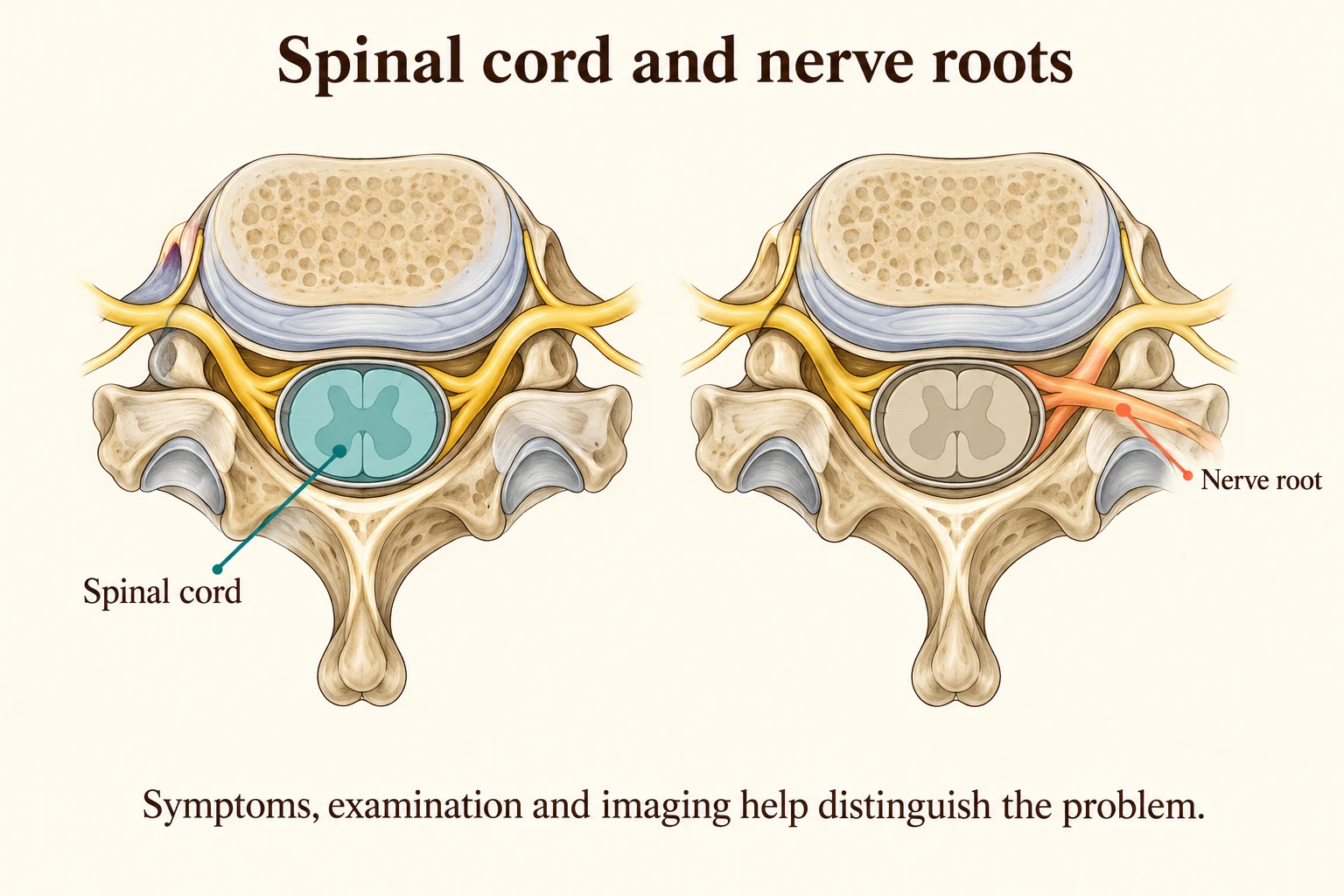
Original educational illustration. Matched cervical spine cross-sections highlight the central spinal cord and an exiting nerve root.
Cord and nerve-root problems can have different implications. Symptoms, examination and imaging are considered together; this orientation drawing cannot diagnose the source of numbness or weakness.
Illustration references: Reference 1 · Reference 2
1. Compare the problem before comparing the operation names
Ask the surgeon to point to the affected level and explain whether the main concern involves a nerve root, the spinal cord, or both. An operation intended to relieve arm symptoms may have different goals from one intended to address spinal-cord compression. Your conversation should identify the problem in a sentence you can repeat without relying on an acronym.
Bring a short list of priorities: using your hand, sleeping through arm pain, walking more steadily, or returning to a particular task. Ask which of these the proposed operation is expected to help and which may need a separate plan. That distinction is more useful than a general promise of a better neck.
Sources: Cervical Radiculopathy: Surgical Treatment Options · Cervical Radiculopathy (Pinched Nerve)
2. Understand what ACDF changes
Anterior cervical discectomy and fusion, or ACDF, reaches the spine from the front of the neck, removes the relevant disc, and joins the treated vertebrae. Ask how many levels are included and why a fusion is being recommended for your findings. Hardware, a spacer, and bone healing serve different roles; ask the surgeon to show each on a diagram.
The practical discussion is about your proposed operation, not every possible fusion. Would the same number of levels be treated with another approach? What does the team expect you to notice about movement? Which symptoms may remain despite a technically successful operation? Write down any uncertainty that matters to your decision.
Sources: Cervical Radiculopathy: Surgical Treatment Options · ACDF: Surgery for Cervical Radiculopathy and Neck Pain
3. Ask what makes disc replacement a reasonable option
Cervical disc replacement uses an artificial disc with the aim of maintaining movement at the treated level. It is an option for selected patients, not a general upgrade from fusion. Ask which features of your joints, alignment, bone, and affected levels support or limit its use.
If you have read a favorable study or testimonial, ask whether those patients resembled you. Request a discussion of device-specific considerations, the surgeon's experience with the proposed implant, and what follow-up would involve. A useful answer should explain why preserving motion is relevant in your case rather than treating movement as the only outcome that matters.
4. Clarify what a posterior operation can address
A posterior cervical laminoforaminotomy approaches the area from the back of the neck and can create space for a nerve in selected circumstances. Ask where the compression sits and whether the planned access can address it adequately. Not every posterior operation is the same, and some neck conditions require a different procedure or stabilization.
Have the surgeon label what would be removed, preserved, or added. Ask how the proposal changes if there is more than one affected level or another source of symptoms. This prevents a misleading comparison between an extensive operation on one side of the table and a narrowly targeted procedure on the other.
5. Compare tradeoffs in your own circumstances
Each approach has a distinct set of concerns. With anterior neck surgery, swallowing and voice changes belong in the discussion. With any proposed operation, ask about nerve or spinal-cord injury, infection, incomplete relief, and possible further surgery. The team should explain which concerns are most relevant to your anatomy and health.
Discuss your work, caregiving, previous neck surgery, and any existing swallowing or voice problem. Ask what recovery would require from someone living alone or relying on public transportation. Prefer a side-by-side explanation of restrictions and follow-up over a ranking based on incision size or an advertised recovery time.
Sources: ACDF: Surgery for Cervical Radiculopathy and Neck Pain · Cervical Radiculopathy: Surgical Treatment Options
6. Leave with the reason for the recommendation
Ask whether continued nonsurgical care remains reasonable, what would make the decision more urgent, and what could change the recommendation. A second opinion is most useful when it reviews the same images and answers the same questions. New or worsening neurological changes should be assessed promptly rather than waiting for a comparison appointment.
At the end, summarize what you heard: the target, the chosen approach, the main alternative, and the expected limits. Invite the surgeon to correct your understanding. You do not need to know every technical detail, but you should understand why this operation is being proposed for you.
Sources: Cervical Radiculopathy (Pinched Nerve) · Cervical Spondylotic Myelopathy (Spinal Cord Compression)
Make the most of your visit
Questions to bring to your consultation
Choose the questions that matter most to you. Bring them along, and ask us to explain anything that is unclear.
- Is the main concern my nerve root, spinal cord, or both?
- Why do you recommend this approach for the exact levels involved?
- What makes me eligible or ineligible for disc replacement?
- Could a posterior approach address the same problem adequately?
- Which symptoms are least likely to improve with this operation?
- How do my existing swallowing, voice, or bone-health issues change the plan?
- What would make waiting or continuing nonsurgical care unsafe?
Sources & further reading
- Cervical Radiculopathy: Surgical Treatment OptionsAAOS OrthoInfo
- Cervical Radiculopathy (Pinched Nerve)AAOS OrthoInfo
- ACDF: Surgery for Cervical Radiculopathy and Neck PainHospital for Special Surgery
- Cervical Spondylotic Myelopathy (Spinal Cord Compression)AAOS OrthoInfo
We use these medical sources to help explain your options and prepare you for a conversation with our team. Our guides feature our own clinicians; patient reviews describe individual experiences.