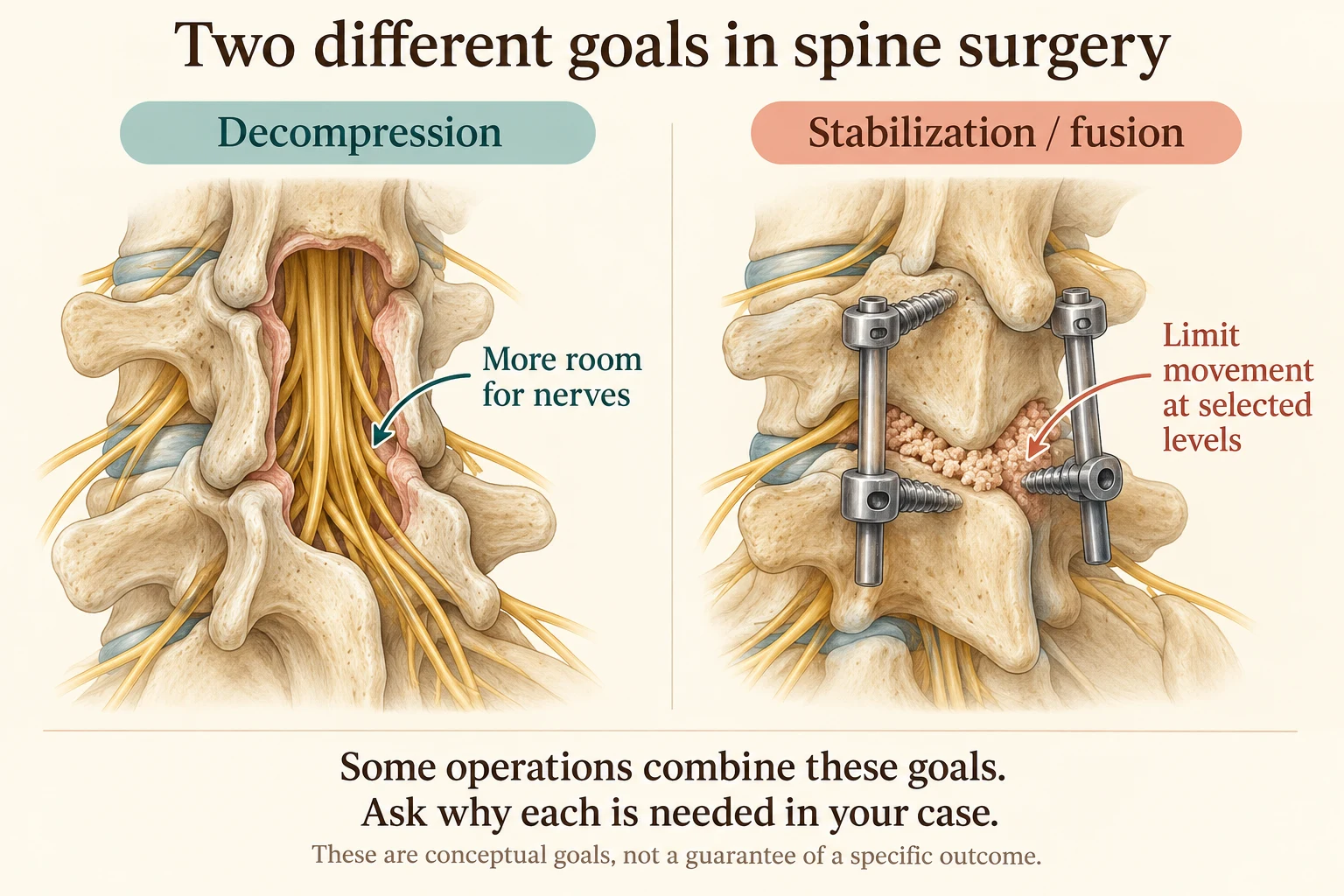
Original educational illustration. Schematic lumbar diagrams contrast making room for nerves and limiting movement at selected levels.
Decompression and stabilization address different goals and may be combined. Ask why each is proposed in your case, what alternatives exist, and what recovery involves. Hardware placement is schematic.
Illustration references: Reference 1 · Reference 2
1. Ask what problem requires a fusion
A fusion joins selected vertebrae; decompression creates space around nerves. They may be combined, but they solve different aspects of a problem. Before discussing an approach, ask what finding makes stabilization necessary and what the surgeon expects it to add to symptom relief or function.
Write down the main symptom you want improved and ask how it relates to the proposed levels. If decompression without fusion is an alternative, ask why it is or is not appropriate. If the recommendation involves more than one level, request an explanation for each. Understanding the purpose prevents an acronym from becoming the decision itself.
Sources: Spinal Fusion · Lumbar Spinal Stenosis
2. Translate the route into a simple drawing
ALIF refers to an anterior lumbar interbody fusion, approaching from the front. TLIF is a transforaminal lumbar interbody fusion, approaching from the back. Lateral approaches come from the side. These labels do not fully describe the operation, the implants, or whether additional work is planned through another incision.
Ask the surgeon to draw the path on a simple body outline and mark the treated level. Have them show where the spacer, graft, and screws would sit. Keep the drawing with your visit notes. It can help you ask clearer questions about expected discomfort, wound care, positioning, and the practical help you may need afterward.
Sources: Spinal Fusion
3. Find out why that route fits your anatomy
The appropriate approach depends on the spinal problem and individual anatomy. A description of one route as less invasive does not establish that it is the best choice for every patient. Ask what the selected route allows the surgeon to accomplish and what would be harder or less appropriate through another route.
Bring information about previous spine or abdominal operations and ask how that history is considered. Ask whether other clinicians will participate in access or recovery and how their roles fit together. You should be able to explain why the recommendation suits your case without relying on marketing terms or a general claim of faster healing.
Sources: Spinal Fusion · Minimally Invasive Spine Surgery
4. Compare risks at the level of the whole operation
Ask about approach-specific concerns as well as risks shared by spine operations, including infection, nerve injury, persistent symptoms, and further surgery. A useful comparison accounts for the complete proposed procedure. Comparing only incision lengths leaves out much of the decision.
Request a plain-language explanation of which structures are near the planned access route and how the team protects them. Ask what might cause the operative plan to change and how that possibility is addressed in consent. The objective is not to memorize anatomy. It is to understand the tradeoff the team is making and the important uncertainties you are accepting.
Sources: Spinal Fusion · Minimally Invasive Spine Surgery
5. Understand the difference between support and healing
Implants support the treated area while the intended fusion develops; they are not the same as healed bone. Bone health may affect planning, so ask whether osteoporosis assessment or treatment is relevant before surgery. Ask what the team will use to judge healing and how that differs from judging pain relief.
Discuss the activities that matter most to you, such as lifting at work, caring for a family member, or returning to exercise. Rather than seeking one date for being fully recovered, ask which milestones govern each activity. Make sure rehabilitation instructions reflect the actual operation and any additional health needs.
Sources: Spinal Fusion · Preoperative Osteoporosis Assessment
6. Compare the recovery plans you would actually follow
Ask where surgery will take place, whether an overnight stay is expected, and what would change the discharge plan. Confirm who handles wound questions, medication adjustments, and rehabilitation referrals. A proposed approach should come with a practical explanation of the care surrounding it.
For a second opinion, bring the same images and the first surgeon's proposed operation. Ask the second clinician to explain any difference in the goal, levels, or route. If both approaches are reasonable, discuss how your priorities influence the choice. A clear account of benefits, burdens, and alternatives is more valuable than an unsupported claim that one acronym is universally best.
Sources: Spine surgery — discharge · 10 Questions to Ask Before Having an Operation
Make the most of your visit
Questions to bring to your consultation
Choose the questions that matter most to you. Bring them along, and ask us to explain anything that is unclear.
- What makes fusion necessary in addition to any decompression?
- Which levels are included, and why does each need treatment?
- Why do you prefer this access route for my anatomy and surgical history?
- Will the operation involve more than one incision or surgical team?
- Which risks differ meaningfully between my reasonable options?
- How will you assess bone healing separately from symptom improvement?
- What milestones will govern my return to work and exercise?
Sources & further reading
- Spinal FusionAAOS OrthoInfo
- Lumbar Spinal StenosisAmerican Association of Neurological Surgeons
- Minimally Invasive Spine SurgeryAmerican Association of Neurological Surgeons
- Preoperative Osteoporosis AssessmentCongress of Neurological Surgeons
- Spine surgery — dischargeNIH / MedlinePlus
- 10 Questions to Ask Before Having an OperationAmerican College of Surgeons
We use these medical sources to help explain your options and prepare you for a conversation with our team. Our guides feature our own clinicians; patient reviews describe individual experiences.