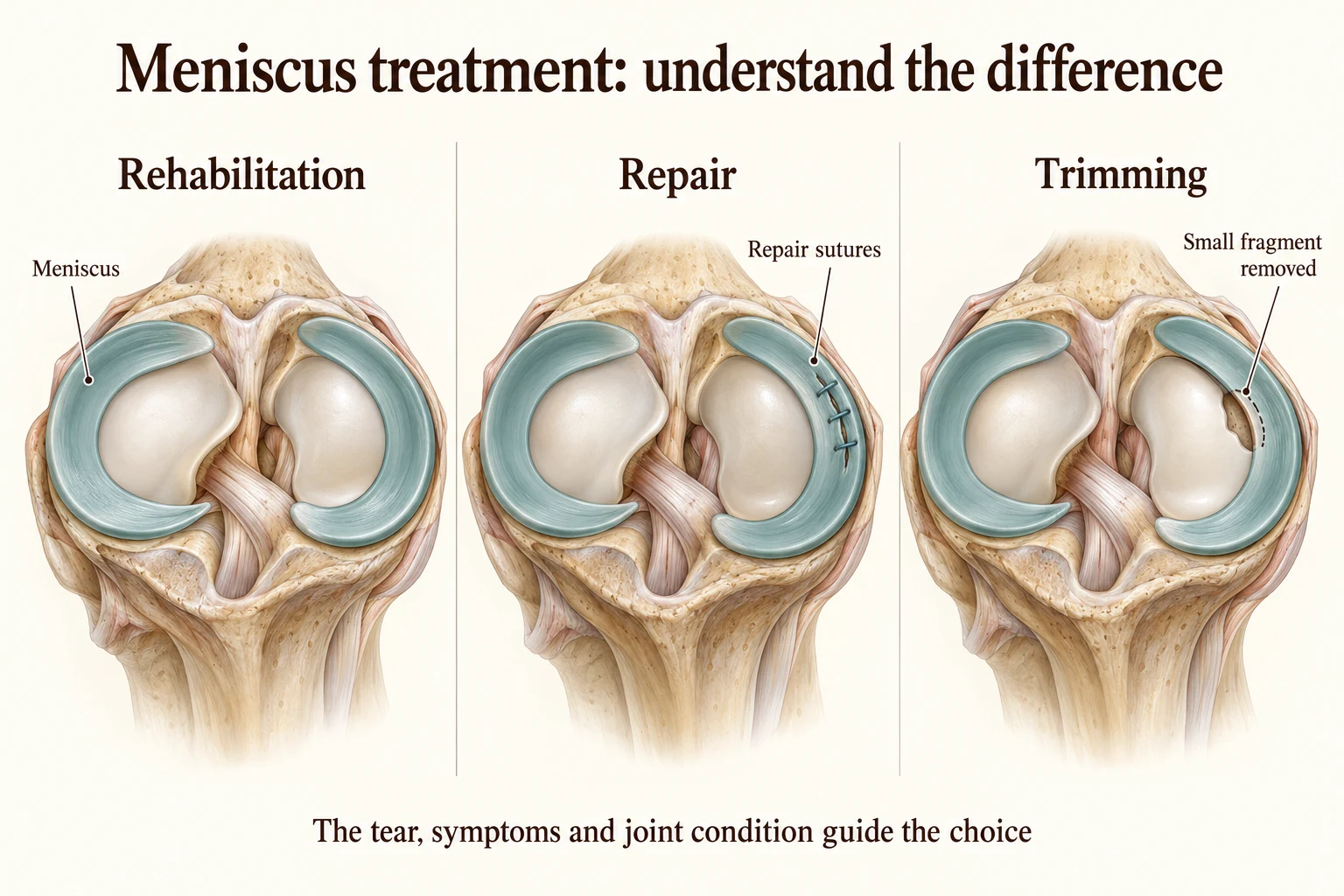
Original educational illustration. Three schematic panels introduce rehabilitation, meniscus repair and trimming.
Ask what each option is intended to accomplish, what tissue would be preserved or removed, and how rehabilitation would differ. Tear type, symptoms, arthritis and other findings influence the choice.
Illustration references: Reference 1 · Reference 2
1. Ask which root is torn and how it was identified
There are menisci on the inner and outer sides of the knee, with attachments that help them function under load. Ask the clinician to show the tear and explain the quality of the surrounding tissue. A report saying meniscus tear may not communicate the importance of a root injury. Bring the MRI images, not just the report, and describe when pain began. If the knee changed suddenly during an ordinary activity, that history is useful even without a major sporting injury.
2. Understand why the attachment matters
Mayo Clinic describes how loss of the root attachment can impair load distribution and contribute to abnormal stress on the joint. Repairing an attachment is therefore a different objective from trimming a loose fragment. Ask what function the proposed operation is trying to preserve and whether the tissue is suitable for that goal. The anatomical explanation should be clear enough that you can distinguish the operation from a general knee clean-up. It should also acknowledge what existing joint damage cannot be reversed.
3. Assess arthritis, alignment and the whole knee
Eligibility for repair depends on joint condition and overall health, not age alone. Ask about cartilage wear, leg alignment, the condition of the underlying bone and other ligament or meniscus injuries. Mayo emphasizes that root repair is generally considered in knees with limited arthritis. If repair is not recommended, ask which feature changes the balance and what alternatives fit. If another procedure is suggested at the same time, request a separate explanation of its purpose and recovery implications.
4. Compare complete treatment pathways
Discuss rehabilitation, symptom management, repair and other surgical options where appropriate. Ask what each pathway is expected to accomplish and how the knee will be followed if you choose nonsurgical care. A repair recommendation should explain the expected benefit and uncertainty, including the possibility of incomplete healing or persistent symptoms. A nonsurgical recommendation should also have a plan rather than simply ending the conversation. Tell the clinician whether your main goal is comfortable daily walking, physical work or returning to a particular activity.
Sources: Meniscus tears and repairs
5. Make the protection period practical
Ask for the specific walking, brace and bending instructions anticipated after your operation. Root-repair precautions can differ from those after a simple meniscus trim. Bring details about stairs, transportation, your job and who could help at home. Have someone teach you the required walking-aid technique before relying on it. If the anticipated restrictions are not feasible, say so before scheduling; that constraint belongs in the treatment decision. Ask what support can be arranged and what would make a different approach more reasonable.
Sources: Meniscus tears and repairs
6. Agree on progress checks
Find out how the surgeon and therapist will judge readiness to advance loading, movement and strength work. Ask who can authorize a change and how the final operative findings reach the therapist. A calendar estimate should be paired with assessments relevant to the repair. Keep follow-up even if pain improves early, because symptom relief alone does not establish tissue healing. Conversely, tell the team if pain or swelling interferes with the plan so the difficulty can be assessed rather than silently working around it.
Sources: Meniscus tears and repairs
7. Use another opinion to clarify the decision
If recommendations differ, compare the reasoning about cartilage condition, alignment, repairability and recovery demands. Ask each clinician to review the same images and treatment history. A patient account can show what communication or support felt like, but it cannot establish that your tear has the same prognosis. Our knee profiles can help you identify a consultation; confirm the individual clinician's experience with root tears before assuming a particular repair is offered. Leave with a clear explanation of the decision and the next step.
Make the most of your visit
Questions to bring to your consultation
Choose the questions that matter most to you. Bring them along, and ask us to explain anything that is unclear.
- Which root is torn, and what do the images show?
- How does the tear affect the meniscus function?
- How do cartilage wear and alignment affect repair suitability?
- What are the reasonable alternatives for my knee?
- What walking and bending restrictions would apply?
- How will readiness to advance rehabilitation be assessed?
- What uncertainty would another opinion help resolve?
Sources & further reading
- Advances in treatment of meniscus root tearsMayo Clinic
- Meniscus tears and repairsMayo Clinic
We use these medical sources to help explain your options and prepare you for a conversation with our team. Our guides feature our own clinicians; patient reviews describe individual experiences.