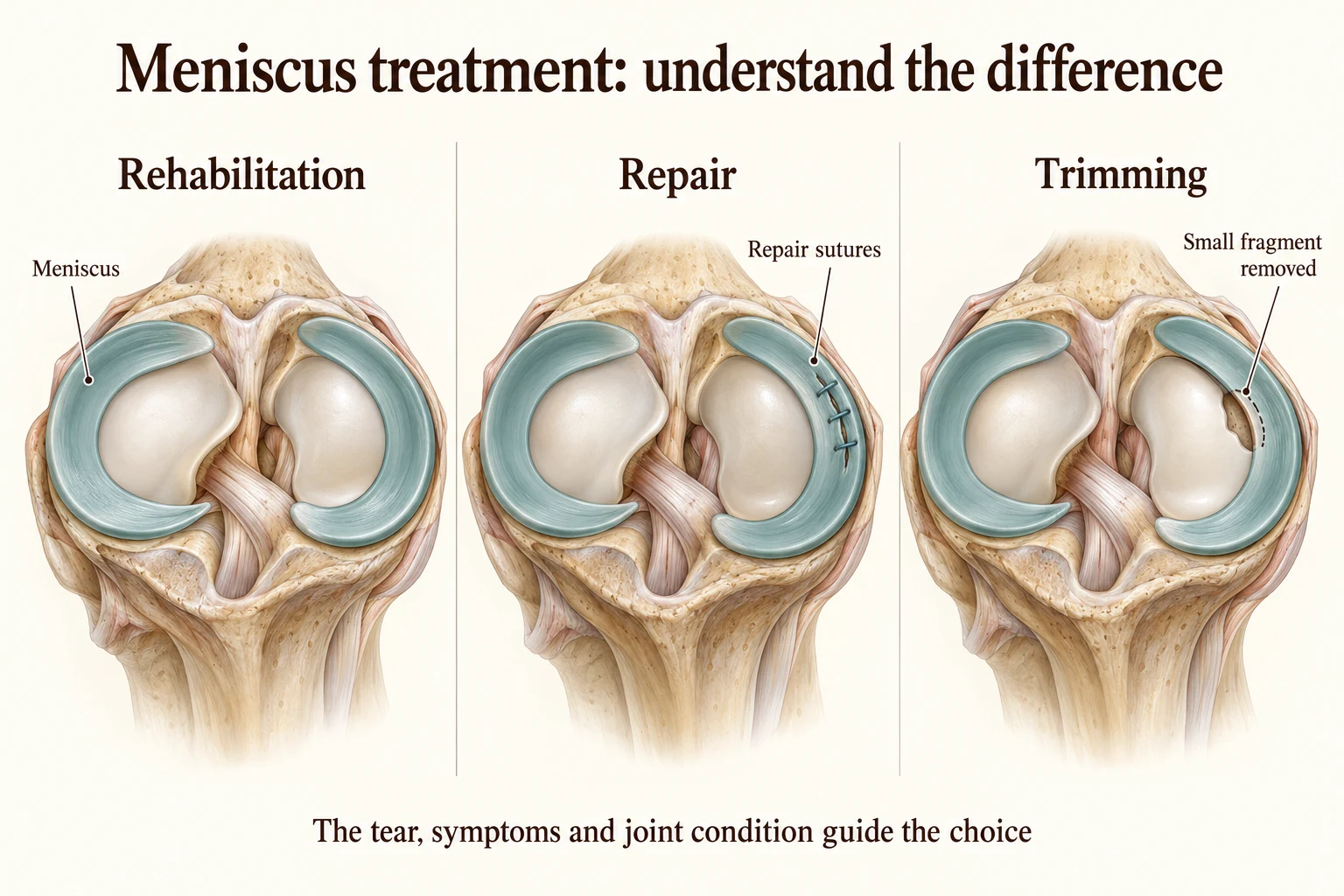
Original educational illustration. Three schematic panels introduce rehabilitation, meniscus repair and trimming.
Ask what each option is intended to accomplish, what tissue would be preserved or removed, and how rehabilitation would differ. Tear type, symptoms, arthritis and other findings influence the choice.
Illustration references: Reference 1 · Reference 2
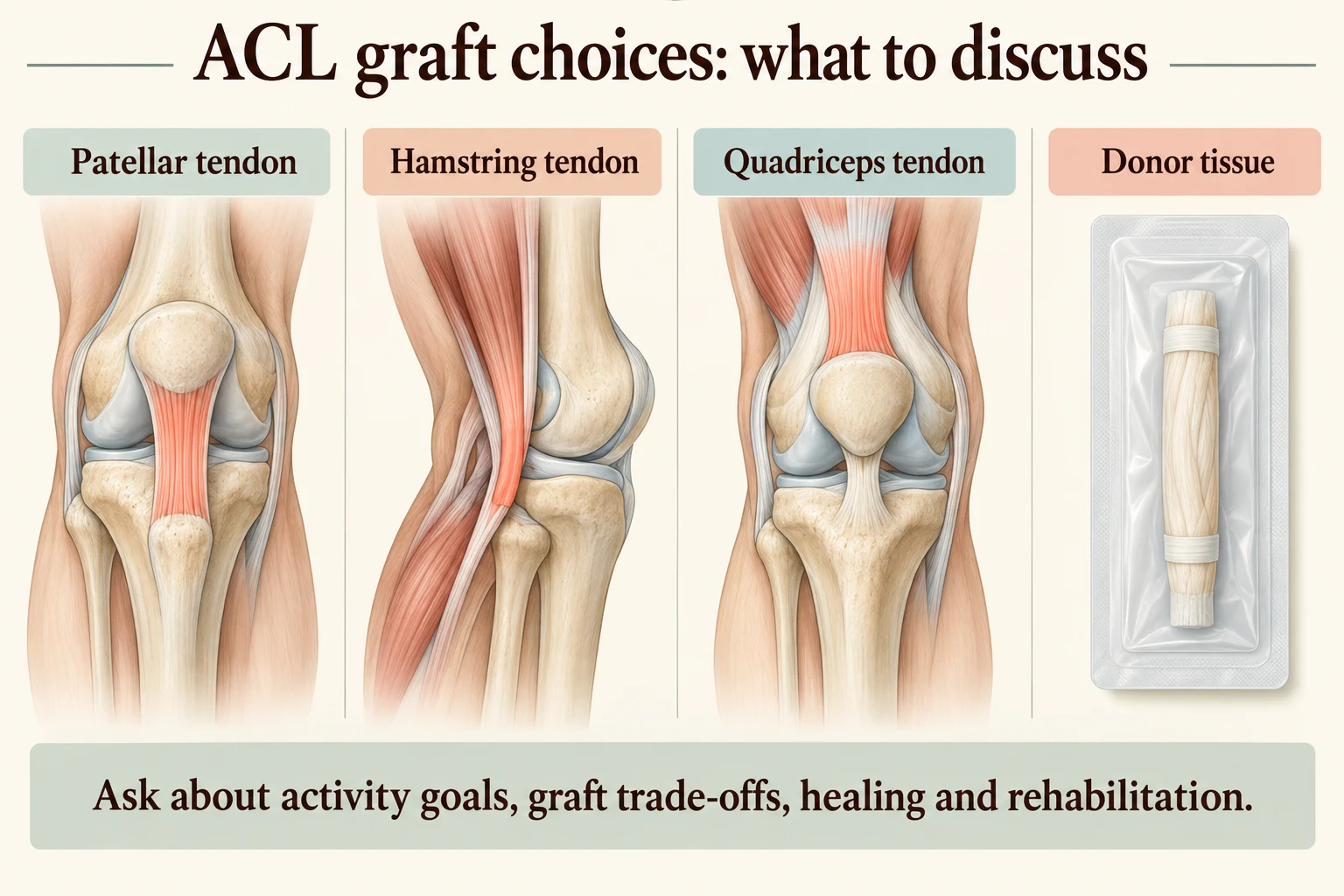
Original educational illustration. Knee schematics indicate patellar, hamstring and quadriceps tendon sources alongside a donor-tissue symbol.
Ask about activity goals, graft trade-offs, healing and rehabilitation. The drawings identify general tissue sources, not a graft-harvesting technique or a ranking of options.
Illustration references: Reference 1 · Reference 2
1. The meniscus procedure must be identified precisely
Ask whether the meniscus will be repaired, partly trimmed or assessed during arthroscopy before a final decision. The tear location and pattern matter, and a root repair can introduce additional considerations. A generic description of ACL surgery may leave these differences hidden. Request a written summary after the operation and confirm that your therapist receives it. The rehabilitation plan should reflect the tissue that needs to heal, rather than a standard schedule borrowed from someone who had an isolated ACL reconstruction.
Sources: Meniscus Surgery: Meniscectomy, Transplant, and Repair
2. Walking instructions may need a different protection phase
Ask how much weight you may place through the leg, which walking aids are needed and who can change those instructions. Do not assume that an ACL protocol found online accounts for the meniscus repair. Practice the prescribed technique with a professional and discuss stairs, transfers and the route into your home. If your job or caregiving responsibilities make the restrictions difficult, raise that issue before surgery. The choice of treatment includes whether you can carry out the recovery it requires.
Sources: Meniscus Surgery: Meniscectomy, Transplant, and Repair
3. Bending and exercise choices may be adjusted
The permitted motion and loading can depend on the repair pattern and the surgeon's protocol. Ask which movements are allowed, which are restricted and how those instructions will be updated. A limit on one type of activity does not mean every exercise should stop; the therapist needs a clear plan for safe work during protection. Avoid experimenting with deep bending or loaded tasks to prove that the knee feels ready. Symptoms alone cannot establish that a repair can tolerate every movement.
Sources: Meniscus Surgery: Meniscectomy, Transplant, and Repair
4. Early improvement is not the same as completed healing
Pain and swelling may settle before tissue is ready for higher demands. Ask which findings the team uses to advance the plan and how it distinguishes expected progress from a problem. The ACL reconstruction also requires rehabilitation regardless of the meniscus procedure. Keep the scheduled reviews even if daily walking becomes easier. If new locking, giving way or a significant symptom change occurs, contact the team rather than waiting until the next planned sport milestone. A change in symptoms should be interpreted in context.
5. Return-to-sport testing must reflect both procedures
Ask how the clinician and therapist will assess strength, movement quality, symptoms and confidence before running, pivoting or contact activity. Practice, unrestricted training and competition are different steps. A teammate's return date may not account for the same meniscus work, graft or sport demands. Tell the team about season pressure, work deadlines and therapy access. These factors can shape planning, but they should not replace the clinical assessment. Agree who gives clearance and how the decision reaches coaches or employers with your permission.
6. The team needs a shared plan for setbacks
Find out whom the therapist contacts if instructions are unclear and what you should do while waiting for an answer. Ask how to handle a missed appointment, a flare or difficulty following the home plan. Keep one current version of the restrictions rather than combining several printouts. At Commons Clinic, tell us which outside professionals are involved so the evaluation can account for the whole course of care. Patient accounts about helpful explanations may offer context, but your combined procedure and progress must guide the actual rehabilitation decisions.
Ask for the instructions to include the date and the procedure they refer to. If one sheet describes meniscus repair and another describes trimming, that is a reason to clarify the record rather than select the less restrictive plan. Bring the discrepancy to both the surgical and therapy teams. Keeping the final operation summary available can prevent the same confusion from recurring when you change therapists or return after a break.
Make the most of your visit
Questions to bring to your consultation
Choose the questions that matter most to you. Bring them along, and ask us to explain anything that is unclear.
- Was the meniscus repaired or trimmed, and what pattern was treated?
- Which walking restrictions come from the meniscus repair?
- What bending or loading limits apply?
- How will you assess readiness to progress?
- What changes should trigger an earlier review?
- How will return-to-sport testing reflect both procedures?
- Who resolves conflicting instructions between the surgeon and therapist?
Sources & further reading
- Meniscus Surgery: Meniscectomy, Transplant, and RepairHospital for Special Surgery · Published September 17, 2023
- Management of ACL Injuries: Plain Language SummaryAmerican Academy of Orthopaedic Surgeons
We use these medical sources to help explain your options and prepare you for a conversation with our team. Our guides feature our own clinicians; patient reviews describe individual experiences.