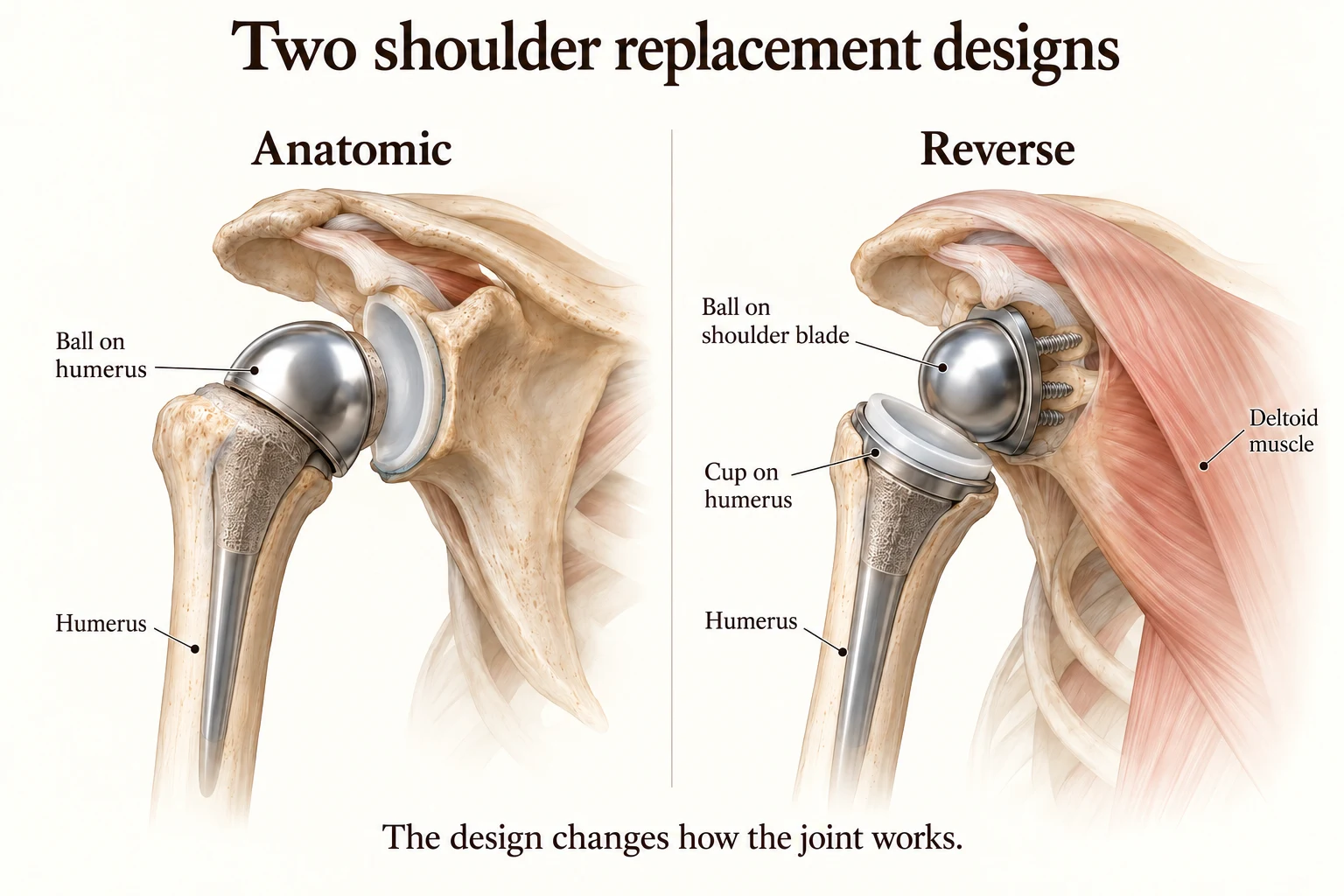
Original educational illustration. Anatomic replacement places the ball on the humerus; reverse replacement places the ball on the shoulder-blade side and the cup on the humerus.
The implant arrangement changes how the joint works. Discuss the rotator cuff, bone, deltoid function and goals that influence the choice; neither drawing identifies the right procedure for every patient.
Illustration references: Reference 1 · Reference 2
1. Ask why the tear is considered irreparable
The discussion may involve tendon retraction, tissue quality, muscle changes and other features of the shoulder. Ask which findings lead to the conclusion and whether they are clear on imaging or may be confirmed during surgery. A very large tear and an irreparable tear are not automatically identical descriptions. Request an explanation that connects the anatomy with the proposed treatment. If opinions differ, compare what each clinician thinks is repairable and what outcome they expect from attempting it.
Sources: Management of Rotator Cuff Injuries: Evidence-Based Clinical Practice Guideline
2. Separate pain relief from restoring strength
Tell the clinician whether the main limitation is pain, weakness, loss of active elevation or a combination. Being comfortable at rest and lifting an object away from the body are different goals. Ask which option is most likely to address each one and what limitations may persist. This prevents a pain-relieving procedure from being mistaken for a promise to recreate normal tendon function. Choose a few daily tasks to keep the comparison grounded in the life you want to regain.
Sources: Management of Rotator Cuff Injuries: Evidence-Based Clinical Practice Guideline
3. Discuss a purposeful nonsurgical plan
Rehabilitation and symptom management may be appropriate depending on the shoulder and your goals. Ask what the program will target, how progress is measured and when the plan should be reconsidered. Tell the team about previous therapy and why it stopped or failed to meet your needs. If an injection is discussed, clarify its target, expected role and relationship to possible surgery. Nonsurgical care should come with a review point and a next step, rather than an instruction to tolerate the problem indefinitely.
Sources: Management of Rotator Cuff Injuries: Evidence-Based Clinical Practice Guideline
4. Understand the range of reconstructive choices
Depending on the circumstances, clinicians may discuss partial repair, other arthroscopic procedures, tendon transfer, superior capsular reconstruction or another strategy. These approaches have different aims and evidence, and they are not offered by every surgeon. Ask which options are genuinely relevant to your anatomy and why others are not. Request the exact procedure name and a comparison of pain relief, function, recovery and possible later surgery. Avoid assuming that a newer technique is more effective simply because it preserves the existing joint.
Sources: Management of Rotator Cuff Injuries: Evidence-Based Clinical Practice Guideline
5. Ask when reverse replacement enters the discussion
Reverse shoulder replacement changes the joint mechanics so the deltoid can contribute differently to arm elevation. It may be considered for selected shoulders with severe cuff dysfunction, but suitability depends on more than the tear label. Ask about arthritis, bone condition, muscle and nerve function, and the activities you need to perform. The consultation should explain why replacement is or is not favored and what restrictions and risks it introduces. A replacement is a different commitment from a tendon procedure.
Sources: Reverse Total Shoulder Replacement
6. Compare the recovery commitments
For each realistic option, ask about immobilization, assistance at home, movement restrictions, therapy and return to work. Include the consequences if healing or improvement is limited. If you live alone or use the affected arm for mobility, those facts belong in the decision now. Ask which restrictions are temporary and which could be longer term. You do not need identical timelines to compare choices; you need a clear account of what each pathway asks of you and what benefit it is intended to provide.
7. Use the consultation to make a shared plan
Bring the images, prior operation reports and a short list of the tasks you most want to improve. Ask our shoulder clinicians to explain the diagnosis and appropriate evaluation pathway; confirm specific advanced procedures and experience directly. A second opinion can be useful when the main options differ substantially. Patient accounts about feeling informed or supported may help you select a conversation, but they cannot determine repairability. Leave knowing the next step, the uncertainty that remains and when the decision will be revisited.
Make the most of your visit
Questions to bring to your consultation
Choose the questions that matter most to you. Bring them along, and ask us to explain anything that is unclear.
- Which findings make this tear difficult or impossible to repair?
- Which option targets pain and which targets function?
- What should a nonsurgical trial accomplish?
- Which reconstruction options actually fit my shoulder?
- Why would reverse replacement be considered or avoided?
- What recovery support would each realistic option require?
- Would another opinion clarify an important uncertainty?
Sources & further reading
- Management of Rotator Cuff Injuries: Evidence-Based Clinical Practice GuidelineAmerican Academy of Orthopaedic Surgeons · Published August 18, 2025
- Reverse Total Shoulder ReplacementAmerican Academy of Orthopaedic Surgeons
We use these medical sources to help explain your options and prepare you for a conversation with our team. Our guides feature our own clinicians; patient reviews describe individual experiences.