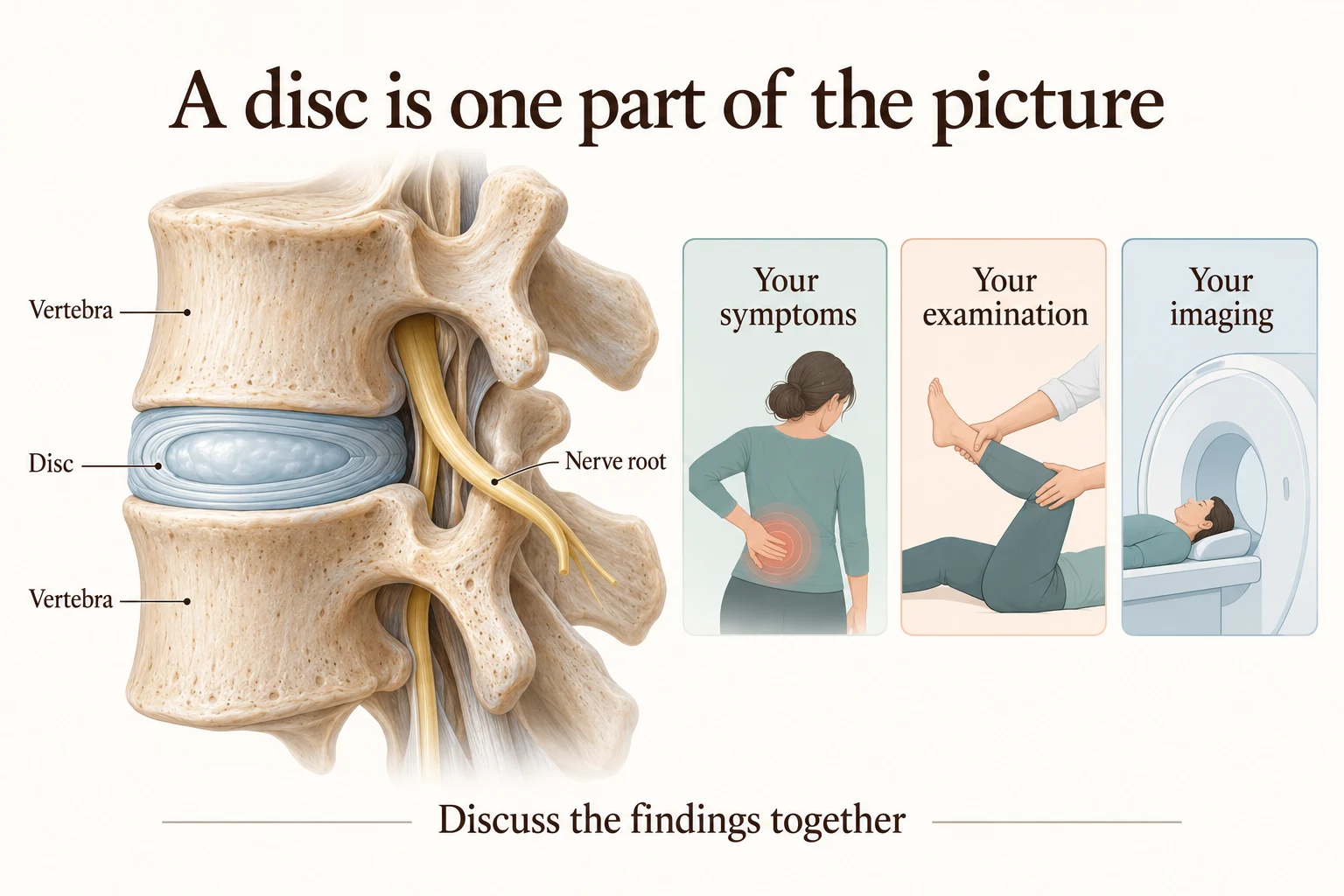
Original educational illustration. A simplified vertebra, disc and nerve illustration alongside symptoms, examination and imaging.
Disc findings are one part of the assessment. Ask which findings fit your symptoms and which activities you want the treatment plan to help you regain.
Illustration references: Reference 1 · Reference 2
1. Ask what source of pain is being proposed
The procedure targets the basivertebral nerve within a vertebral body and is discussed in relation to vertebral endplate-associated pain. Ask the evaluating clinician to explain why that source is suspected in your case and how the history, examination, and imaging fit together.
Start with your own symptom pattern: where pain is felt, which activities bring it on, and how it affects daily life. Ask what findings support the proposed explanation and which findings do not. A useful assessment should make room for uncertainty instead of assigning the MRI term as a complete diagnosis.
Sources: How I Do It: Basivertebral Nerve Ablation for Vertebrogenic Pain
2. Put Modic changes in clinical context
Modic changes describe particular MRI findings near vertebral endplates. The device indication includes selected patients with specified Modic findings and other eligibility criteria. Ask which findings are present and why they are relevant rather than assuming every such change needs treatment.
Have the clinician point to the level on the actual image. Ask whether another finding could explain the symptoms better and what would make the team look for another cause. Keep the written report, but request an explanation of how the images influence the decision beyond the words in the report.
Sources: How I Do It: Basivertebral Nerve Ablation for Vertebrogenic Pain · Intracept Intraosseous Nerve Ablation System — indications for use
3. Review the full selection criteria
FDA clearance for a device concerns its specified use; it is not a promise that the procedure will help every patient with back pain. Ask the clinician to walk through the current device indication, the treatments already tried, and any features that may make the procedure unsuitable.
Bring a concise record of previous care, including what was attempted, how long it was tried, and what changed. If an earlier treatment was stopped because of side effects or access problems, explain that. A meaningful review should distinguish a treatment that did not help from one that was never feasible to complete.
Sources: Intracept Intraosseous Nerve Ablation System — indications for use · How I Do It: Basivertebral Nerve Ablation for Vertebrogenic Pain
4. Ask which evidence applies to your situation
Request an explanation of the relevant studies, including the patients enrolled, the outcomes measured, and the duration of follow-up. Ask whether people with your other spine findings or health conditions were represented. Device clearance and a favorable patient story answer different questions from comparative treatment evidence.
Focus on the outcome you need: a particular activity, more manageable symptoms, or improved function. Ask what improvement is realistic, what remains uncertain, and how the team would describe the chance of no meaningful benefit. Avoid interpreting a study average as a personalized forecast.
Sources: How I Do It: Basivertebral Nerve Ablation for Vertebrogenic Pain · Intracept Intraosseous Nerve Ablation System — indications for use
5. Compare the procedure with a continuing care plan
Ask what reasonable alternatives remain and what continuing nonsurgical care would involve. If a procedure is proposed, clarify what it would add to rehabilitation or other management rather than treating it as a replacement for every part of care.
Discuss the burden of scheduling, transportation, recovery, and cost alongside possible benefit. If you prefer more time to decide, ask what monitoring or care is appropriate during that period. The consultation should help you compare actual options, not merely accept or reject a procedure name that appeared online.
Sources: Back Pain: Diagnosis, Treatment, and Steps to Take · Low back pain and sciatica in over 16s: assessment and management — recommendations
6. Understand preparation, risks, and follow-up
Ask the procedural clinician to describe the risks relevant to the proposed technique and your health history. Share medicines, previous procedures, recent illness, and any concerns about anesthesia or infection. Obtain written instructions if you proceed; do not adapt preparation advice from a different type of injection.
Before scheduling, identify who will perform the procedure and who will assess recovery. Ask what symptoms require urgent contact and how after-hours care is arranged. If more than one practice is involved, make sure the referral includes the clinical question, images, and relevant treatment history.
Sources: How I Do It: Basivertebral Nerve Ablation for Vertebrogenic Pain · Preprocedural Recommendations for Reducing Surgical Site Infections
7. Agree on how success would be judged
Choose a small number of meaningful goals and a review schedule with the treating team. Ask when it is appropriate to evaluate the result and what would prompt earlier reassessment. A lack of improvement should lead to a thoughtful review rather than an automatic sequence of additional interventions.
An evaluation can help determine whether this procedure is relevant to your condition. Ask whether the evaluating clinician provides it or would recommend a referral, and discuss relevant experience, selection, alternatives, and follow-up. An understandable explanation of why a treatment fits—or does not fit—your situation is a valuable part of that assessment.
Sources: How I Do It: Basivertebral Nerve Ablation for Vertebrogenic Pain · Back Pain: Diagnosis, Treatment, and Steps to Take
Make the most of your visit
Questions to bring to your consultation
Choose the questions that matter most to you. Bring them along, and ask us to explain anything that is unclear.
- What makes you suspect vertebral endplate-associated pain in my case?
- How do my MRI findings match my symptoms and examination?
- Do I meet the full current device indication and clinical selection criteria?
- Which studies are most relevant to patients with my other spine findings?
- What reasonable nonsurgical alternatives remain?
- Who would perform the procedure and manage follow-up if I proceed?
- How would we judge benefit and respond if it does not help?
Sources & further reading
- How I Do It: Basivertebral Nerve Ablation for Vertebrogenic PainASRA Pain Medicine
- Intracept Intraosseous Nerve Ablation System — indications for useFDA device clearance record
- Back Pain: Diagnosis, Treatment, and Steps to TakeNIH / NIAMS
- Low back pain and sciatica in over 16s: assessment and management — recommendationsNICE
- Preprocedural Recommendations for Reducing Surgical Site InfectionsASRA Pain Medicine
We use these medical sources to help explain your options and prepare you for a conversation with our team. Our guides feature our own clinicians; patient reviews describe individual experiences.