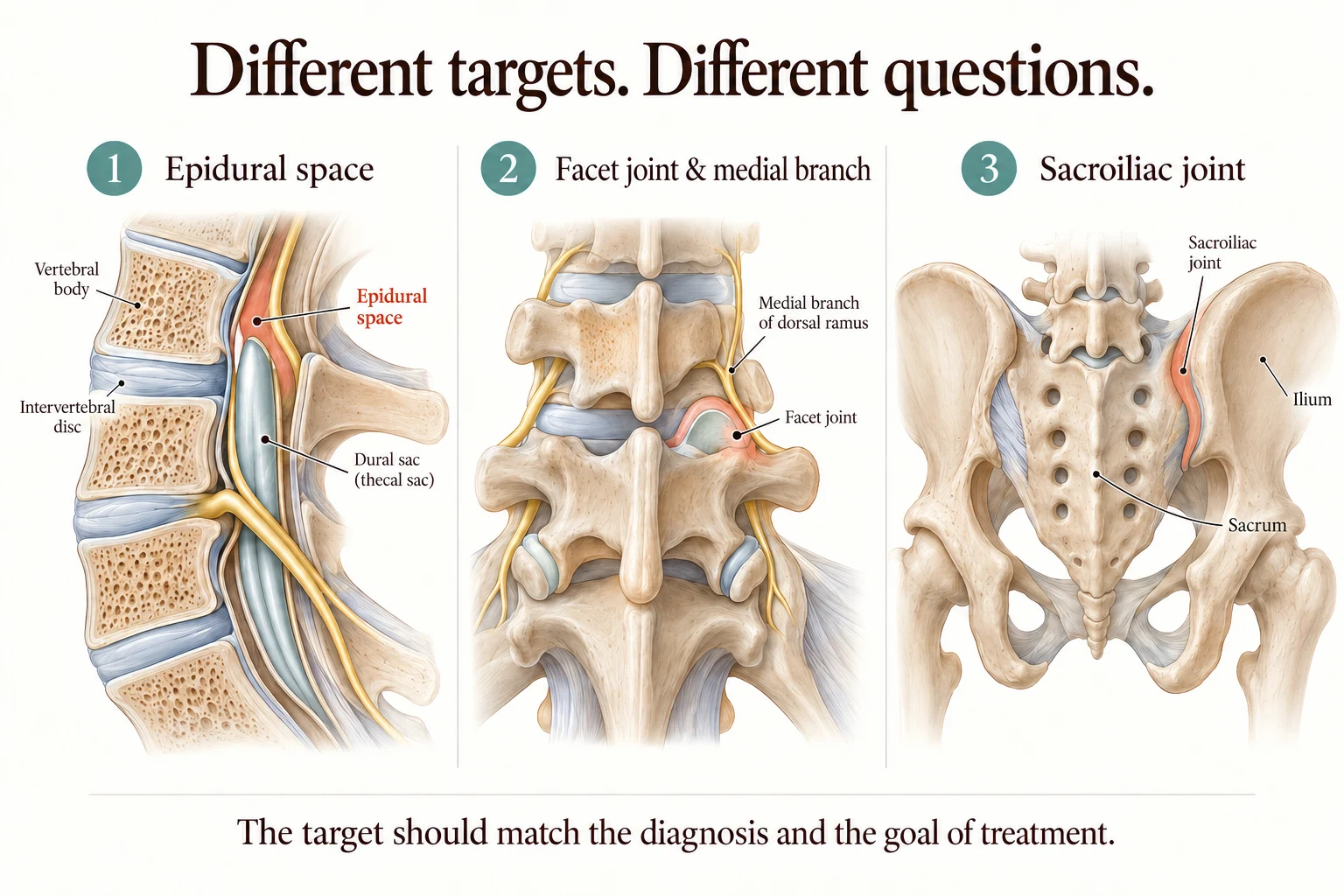
Original educational illustration. Three schematics locate the epidural space, facet joint with a medial branch, and sacroiliac joint.
The epidural space lies outside the dural sac; facet and sacroiliac procedures address different targets. Ask how the target was identified and what outcome would justify treatment. This is an orientation graphic, not an injection technique.
Illustration references: Reference 1 · Reference 2 · Reference 3
1. Begin with the target and the question
Ask the clinician to name the structure being targeted and show it on a diagram. An epidural injection, a facet-joint injection, a medial branch block, and a sacroiliac injection are not interchangeable. The body region, side, and level belong in the explanation as well as the procedure name.
Try summarizing the proposal in one sentence: this procedure is intended to address this symptom by targeting this structure. Ask the clinician to correct anything missing. If the purpose remains unclear, request more explanation before treating the appointment as a routine next step.
Sources: Epidural Injections · Facet Joint Block · Consensus Practice Guidelines on Sacroiliac Joint Complex Pain
2. Ask what an epidural injection is intended to help
An epidural injection places medicine in the space around spinal nerves. Evidence and expectations depend on the diagnosis; relief of radiating nerve symptoms is not the same question as treatment of nonspecific back pain. Ask which symptom the proposed injection is expected to change.
Write down a functional goal, such as tolerating a therapy session or walking to a nearby destination. Ask what level and duration of improvement would make the procedure worthwhile. Avoid interpreting a temporary change in pain as proof that every finding on a scan has been treated.
Sources: Epidural Injections · Epidural steroid injections for chronic back pain: An AAN systematic review
3. Distinguish a facet-joint injection from a medial branch block
A facet-joint injection targets a small joint of the spine. A medial branch block targets nerves supplying facet joints. These terms are sometimes used loosely in conversation, so ask the team to identify the exact procedure and explain the question it is meant to answer.
If a block is being discussed before radiofrequency treatment, ask how the response will be measured and how uncertainty will be handled. A test result is information for a decision, not a guarantee of lasting relief. Ask what the plan would be after a clearly positive, clearly negative, or difficult-to-interpret response.
Sources: Facet Joint Block · Commonly used interventional procedures for non-cancer chronic spine pain: a clinical practice guideline
4. Clarify what an SI-region injection can establish
The sacroiliac region includes joint and surrounding structures. Ask what examination findings support the proposed target and whether the injection is intended to be diagnostic, therapeutic, or both. A broad label such as pelvic pain does not by itself identify one source.
Describe the activities you want assessed before and after treatment, and ask how to record them. If another body region could also contribute, ask how that possibility is being evaluated. The consultation should explain why this target is being considered now and what the result would change.
Sources: Consensus Practice Guidelines on Sacroiliac Joint Complex Pain
5. Ask about the medicine and the evidence separately
The needle's destination and the medicine delivered are different parts of the decision. Ask what substances are planned, why each is included, and what risks matter with your health history. Mention diabetes, prior reactions, infection concerns, and all medicines you take.
Guidelines do not agree on every spine-pain intervention. Ask which evidence applies to your diagnosis and symptom duration, and whether the anticipated benefit justifies the burden for you. The fact that a procedure is available does not establish that it is the best next step for your situation.
Sources: Epidural Corticosteroid Injections · Epidural steroid injections for chronic back pain: An AAN systematic review · Commonly used interventional procedures for non-cancer chronic spine pain: a clinical practice guideline
6. Arrange a procedure-specific preparation plan
Tell the team about blood thinners, recent illness, antibiotics, allergies, and prior problems with procedures. Obtain written instructions for any medication changes, eating or drinking restrictions, transportation, and activity afterward. Do not independently stop an anticoagulant because you found general injection advice online.
Confirm whom to contact if your health changes before the appointment. Ask which symptoms afterward require urgent attention and how to reach the treating team. A well-organized procedure plan includes the days around the visit, not only the time spent in the procedure room.
Sources: Updates to the ASRA Guidelines for Interventional Pain Procedures · Preprocedural Recommendations for Reducing Surgical Site Infections · Epidural Injections
7. Decide how the result will guide the next step
Before treatment, agree on what to track and when the team will review it. Useful notes include the symptom targeted, activities attempted within instructions, and how any change lasted. Record side effects as well as benefit so that the next decision reflects the whole experience.
Ask what would justify repeating, changing, or stopping the intervention. A procedure sequence should not continue automatically because appointments are already available. We encourage patients to ask how each step advances a broader plan for function and care, including reasonable nonsurgical alternatives.
Sources: Epidural steroid injections for chronic back pain: An AAN systematic review · Commonly used interventional procedures for non-cancer chronic spine pain: a clinical practice guideline
Make the most of your visit
Questions to bring to your consultation
Choose the questions that matter most to you. Bring them along, and ask us to explain anything that is unclear.
- What exact structure, side, and level are you targeting?
- Is this injection intended to diagnose, treat, or both?
- What substances will be used and why?
- Which guideline or evidence best matches my diagnosis and symptom duration?
- How should I coordinate blood thinners and other medicines?
- What result should I record, and when will we review it?
- What would make you recommend against repeating the procedure?
Sources & further reading
- Epidural InjectionsACR / RSNA RadiologyInfo
- Facet Joint BlockACR / RSNA RadiologyInfo
- Consensus Practice Guidelines on Sacroiliac Joint Complex PainASRA Pain Medicine
- Epidural steroid injections for chronic back pain: An AAN systematic reviewAmerican Academy of Neurology
- Commonly used interventional procedures for non-cancer chronic spine pain: a clinical practice guidelineBMJ / international guideline panel
- Epidural Corticosteroid InjectionsJohns Hopkins Medicine
- Updates to the ASRA Guidelines for Interventional Pain ProceduresASRA Pain Medicine
- Preprocedural Recommendations for Reducing Surgical Site InfectionsASRA Pain Medicine
We use these medical sources to help explain your options and prepare you for a conversation with our team. Our guides feature our own clinicians; patient reviews describe individual experiences.