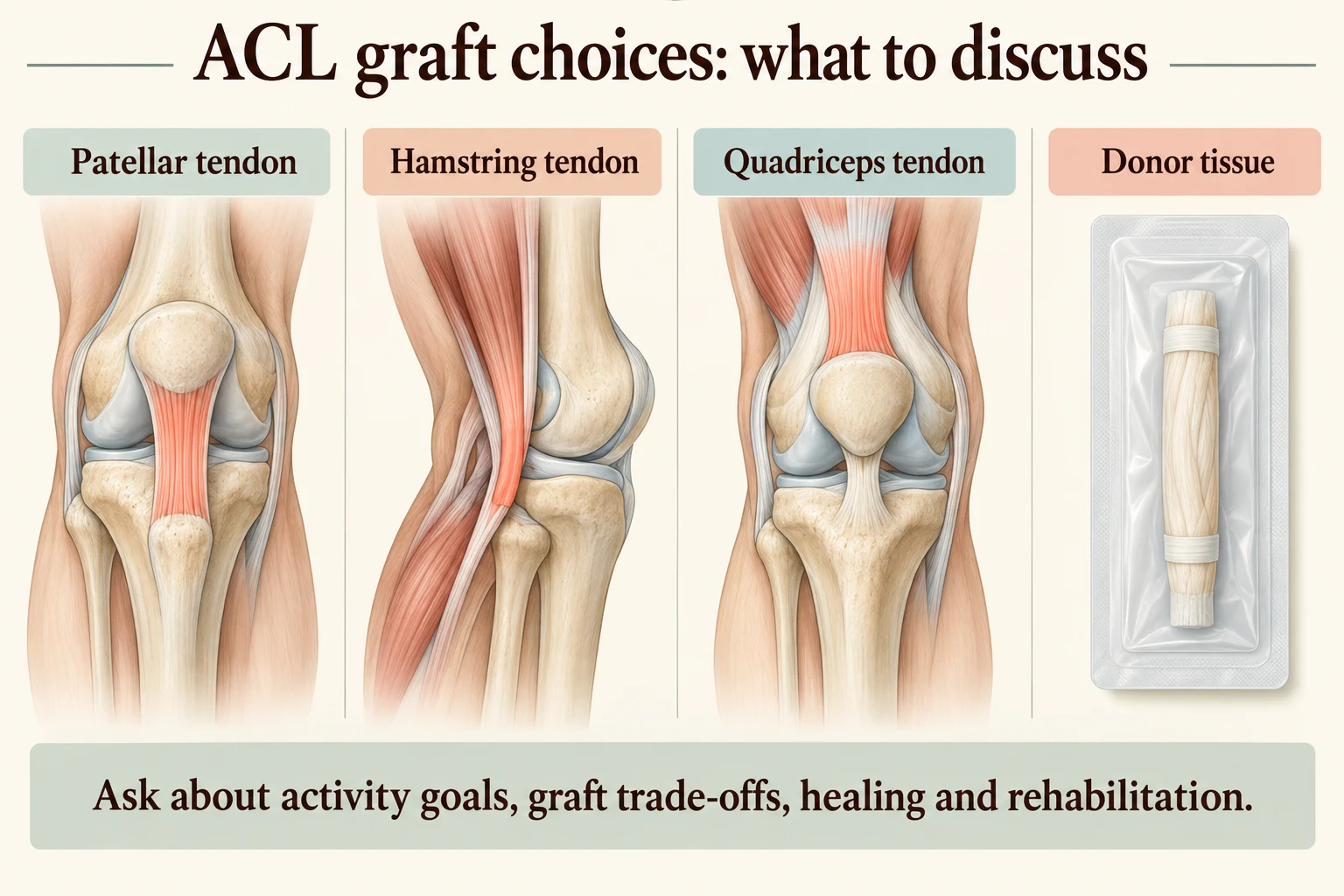
Original educational illustration. Knee schematics indicate patellar, hamstring and quadriceps tendon sources alongside a donor-tissue symbol.
Ask about activity goals, graft trade-offs, healing and rehabilitation. The drawings identify general tissue sources, not a graft-harvesting technique or a ranking of options.
Illustration references: Reference 1 · Reference 2
1. Compare your own tissue with donor tissue
An autograft uses your tissue; an allograft uses donor tissue. The AAOS ACL guideline favors autograft particularly for young or active patients because of outcome and graft-failure considerations. That does not mean the same choice suits every revision, age group or medical situation. Ask why the proposed category fits you and whether the explanation changes with your sport, growth status or previous surgery. A teammate's successful operation is useful context, but it is not a substitute for this comparison.
Sources: AAOS Updates Clinical Practice Guideline for Management of ACL Injuries
2. Discuss patellar-tendon graft tradeoffs
A bone–patellar tendon–bone graft uses tissue from the front of the knee. AAOS describes a tradeoff in skeletally mature patients: this option may reduce graft failure or infection compared with hamstring graft, while anterior or kneeling pain matters in the comparison. Tell the surgeon if your work, worship, childcare or sport involves kneeling. Ask how the harvest area will be assessed and what difficulty there might mean for rehabilitation. Avoid interpreting a lower risk of one problem as freedom from every other problem.
Sources: AAOS Updates Clinical Practice Guideline for Management of ACL Injuries
3. Discuss hamstring graft tradeoffs
Hamstring tendon is another source of autograft tissue. Ask how harvesting it could affect the early rehabilitation plan and the strength demands of your activity. The comparison should include graft suitability, the surgeon's technique and your previous injuries. A choice made to reduce front-of-knee discomfort may carry different considerations elsewhere. Request a plain explanation of why it is favored or not favored for you, and which uncertainty remains. The answer should go beyond a claim that one graft is always more natural or easier.
4. Ask where quadriceps tendon fits
Quadriceps tendon is also used for ACL reconstruction. Ask whether it is among the reasonable options in your case, what tissue would be taken and how the harvest site affects recovery. The fact that it is offered does not establish that it is universally superior to other autografts. Discuss the surgeon's relevant experience and the evidence for your age and activity group. If it is not recommended, ask which feature of your knee or clinical situation explains that decision.
5. Include the rest of the knee
A meniscus repair, cartilage injury, other ligament damage or previous reconstruction can affect the plan. Ask which additional procedures may be needed and whether they change graft choice or rehabilitation. Growing children require a distinct discussion about skeletal maturity and technique. Bring previous operation reports when applicable. The graft is one part of restoring stability; it should not distract from the other structures that contribute to how the knee functions or from the limits of what the operation can accomplish.
6. Ask about the intraoperative backup plan
Sometimes the final tissue or operative findings alter a planned choice. Ask what alternatives could be used, why, and which decisions you are authorizing before surgery. If you have a strong preference or concern about donor tissue, state it explicitly. Request an explanation of fixation, harvest-site care and any additional incisions at the level of detail you find useful. After the operation, ask for the final procedure summary so your rehabilitation team works from what was actually done.
7. Keep return-to-sport expectations separate from graft marketing
No graft eliminates the need for recovery, progressive rehabilitation and assessment before demanding activity. Ask how strength, movement control, symptoms and confidence will be evaluated, and who makes clearance decisions. If a graft is advertised as allowing an unusually quick return, ask what evidence supports that claim for your sport. Our sports medicine profiles can help you arrange a general ACL evaluation. The individual recommendation should connect tissue choice with your goals and the complete recovery plan, not with a promise based on the graft name alone.
Make the most of your visit
Questions to bring to your consultation
Choose the questions that matter most to you. Bring them along, and ask us to explain anything that is unclear.
- Why do you recommend autograft or allograft for me?
- How important is kneeling discomfort in my choice?
- What strength demands could be affected by the harvest site?
- Is quadriceps tendon a reasonable option in my situation?
- Do associated injuries or growth status change the comparison?
- What backup graft choices should we discuss before surgery?
- What functional checks will guide return to sport?
Sources & further reading
- AAOS Updates Clinical Practice Guideline for Management of ACL InjuriesAmerican Academy of Orthopaedic Surgeons · Published September 7, 2022
- ACL Reconstruction Surgery: Procedure and RecoveryHospital for Special Surgery
We use these medical sources to help explain your options and prepare you for a conversation with our team. Our guides feature our own clinicians; patient reviews describe individual experiences.