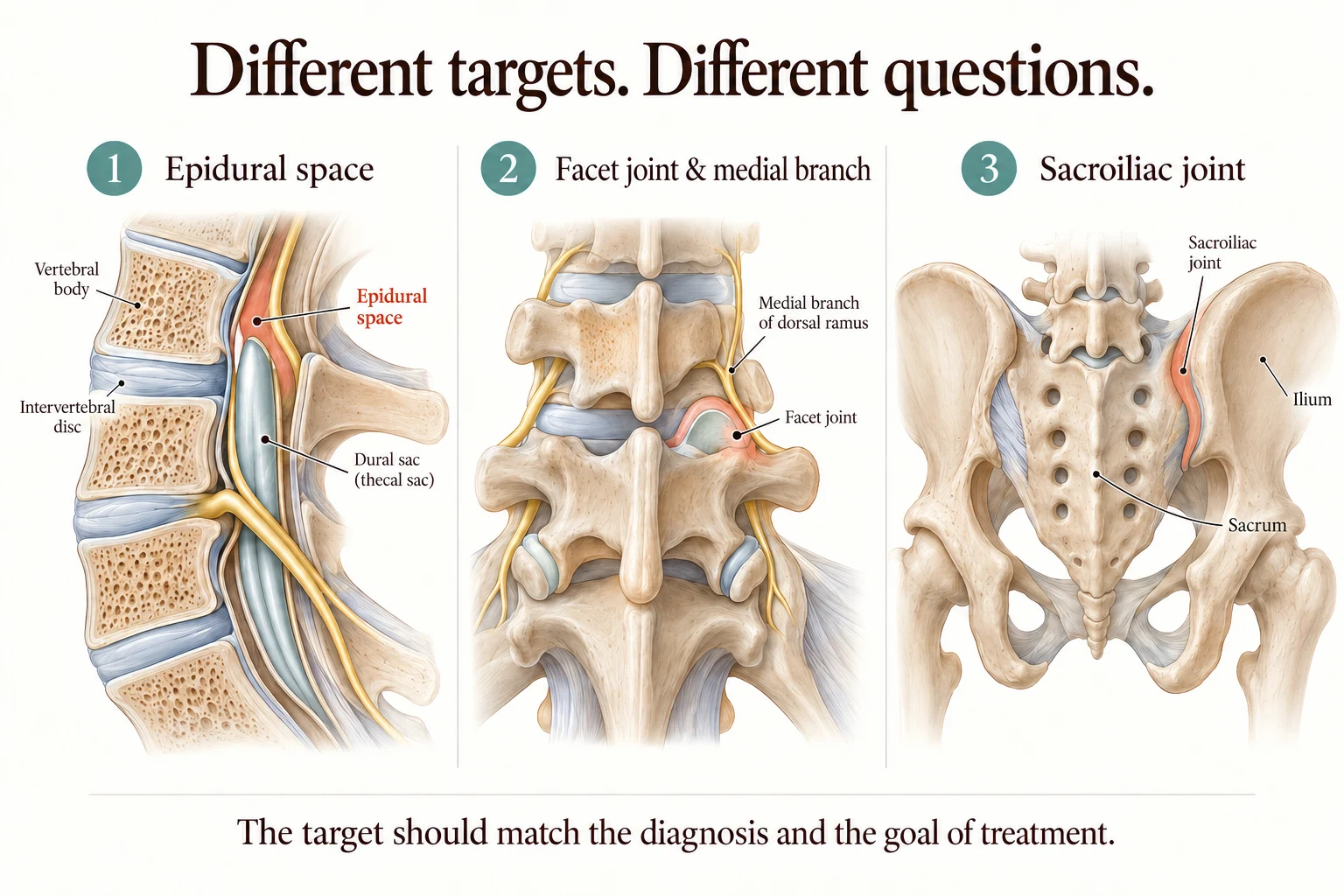
Original educational illustration. Three schematics locate the epidural space, facet joint with a medial branch, and sacroiliac joint.
The epidural space lies outside the dural sac; facet and sacroiliac procedures address different targets. Ask how the target was identified and what outcome would justify treatment. This is an orientation graphic, not an injection technique.
Illustration references: Reference 1 · Reference 2 · Reference 3
1. Report a new concerning symptom first
Follow your procedure team's urgent instructions if you develop new weakness, worsening neurological symptoms, fever, or another concerning change. Severe or rapidly progressing symptoms require urgent assessment. Do not wait for a routine outcome visit when the problem is a possible complication rather than simply a lack of benefit.
Keep the procedure date, name, and treating clinician available. Explain whether the symptom existed before the injection and how it changed afterward. If you are unsure whether to call, contact the team for direction. Avoid assuming that every increase in pain is an expected part of the process.
Sources: Epidural Injections · Epidural Corticosteroid Injections
2. Separate immediate changes from the later course
Ask the clinician how the medicines used might affect the timing of the response. Record what happened soon after the procedure and what happened later instead of compressing the whole experience into helped or did not help. If there was relief, describe which symptom changed and for how long.
A brief diary might note pain location, a practical activity, side effects, and medication use. You do not need to provoke symptoms to test the injection. Follow the activity instructions you were given and ask the team which observations will be most useful at review.
Sources: Epidural Injections · Epidural Corticosteroid Injections
3. Revisit the original purpose of the procedure
A procedure performed to gather diagnostic information may be interpreted differently from one intended primarily to relieve symptoms. Ask what question was being tested and whether the result answers it clearly. If the response was mixed, ask what makes it difficult to interpret.
For example, did one activity improve while another did not? Were several body regions painful before treatment? Did medication or activity change at the same time? Bring those details without trying to decide which explanation is correct. If you received the injection at a different facility, request the procedure report with the target and medicines used. That record can prevent a new clinician from having to infer what happened from a general label. The clinician should connect the response to the original reasoning and explain what remains uncertain.
Sources: Facet Joint Block · Consensus Practice Guidelines on Sacroiliac Joint Complex Pain
4. Ask what a repeat would be expected to add
The rationale for repeating an injection should be explicit. Ask what would be different: the target, the medicine, the goal, or the evidence supporting the choice. A routine series should not replace an individualized discussion of benefit, risks, and alternatives.
Guidance differs for some spine interventions, particularly chronic spine pain. Ask how the recommendation fits the population studied and your response so far. If the main reason offered is that the next attempt might work, ask how likely or meaningful the expected benefit is and what limit the team places on unsuccessful attempts.
Sources: Epidural steroid injections for chronic back pain: An AAN systematic review · Commonly used interventional procedures for non-cancer chronic spine pain: a clinical practice guideline
5. Reassess the broader care plan
An injection outcome is one part of the assessment. Ask whether the diagnosis, rehabilitation program, medicines, or other contributors to symptoms need review. If imaging is proposed, ask what new question it will answer and whether the result could change management.
Bring the goal that matters most to you back into the discussion. If walking, sleep, or work remains difficult, ask what can be addressed now while the team considers the next clinical step. Avoid treating a lack of injection relief as proof that surgery is inevitable or that no other care can help.
Sources: Back Pain: Diagnosis, Treatment, and Steps to Take · Low back pain and sciatica in over 16s: assessment and management — recommendations
6. Leave with a decision and a review point
Ask the clinician to summarize the conclusion: what the result suggests, what it does not establish, and what happens next. Agree on a follow-up date and the symptoms that should prompt earlier contact. If another opinion would be useful, request the procedure report and relevant images so the discussion starts with accurate information.
We value patient accounts of thoughtful follow-up because they show how care felt when a plan needed adjustment. Another patient's eventual improvement cannot predict your result. Your next step should rest on your examination, treatment response, preferences, and a transparent discussion of the evidence.
Sources: 10 Questions to Ask Before Having an Operation · Back Pain: Diagnosis, Treatment, and Steps to Take
Make the most of your visit
Questions to bring to your consultation
Choose the questions that matter most to you. Bring them along, and ask us to explain anything that is unclear.
- Does any symptom after my injection need urgent assessment?
- How should we interpret the timing and duration of my response?
- Was the procedure primarily diagnostic or therapeutic?
- What would a repeat injection do differently?
- Does this result change your working diagnosis or rehabilitation plan?
- What alternatives are reasonable before another procedure?
- When will we review the next step, and who coordinates it?
Sources & further reading
- Epidural InjectionsACR / RSNA RadiologyInfo
- Epidural Corticosteroid InjectionsJohns Hopkins Medicine
- Facet Joint BlockACR / RSNA RadiologyInfo
- Consensus Practice Guidelines on Sacroiliac Joint Complex PainASRA Pain Medicine
- Epidural steroid injections for chronic back pain: An AAN systematic reviewAmerican Academy of Neurology
- Commonly used interventional procedures for non-cancer chronic spine pain: a clinical practice guidelineBMJ / international guideline panel
- Back Pain: Diagnosis, Treatment, and Steps to TakeNIH / NIAMS
- Low back pain and sciatica in over 16s: assessment and management — recommendationsNICE
- 10 Questions to Ask Before Having an OperationAmerican College of Surgeons
We use these medical sources to help explain your options and prepare you for a conversation with our team. Our guides feature our own clinicians; patient reviews describe individual experiences.