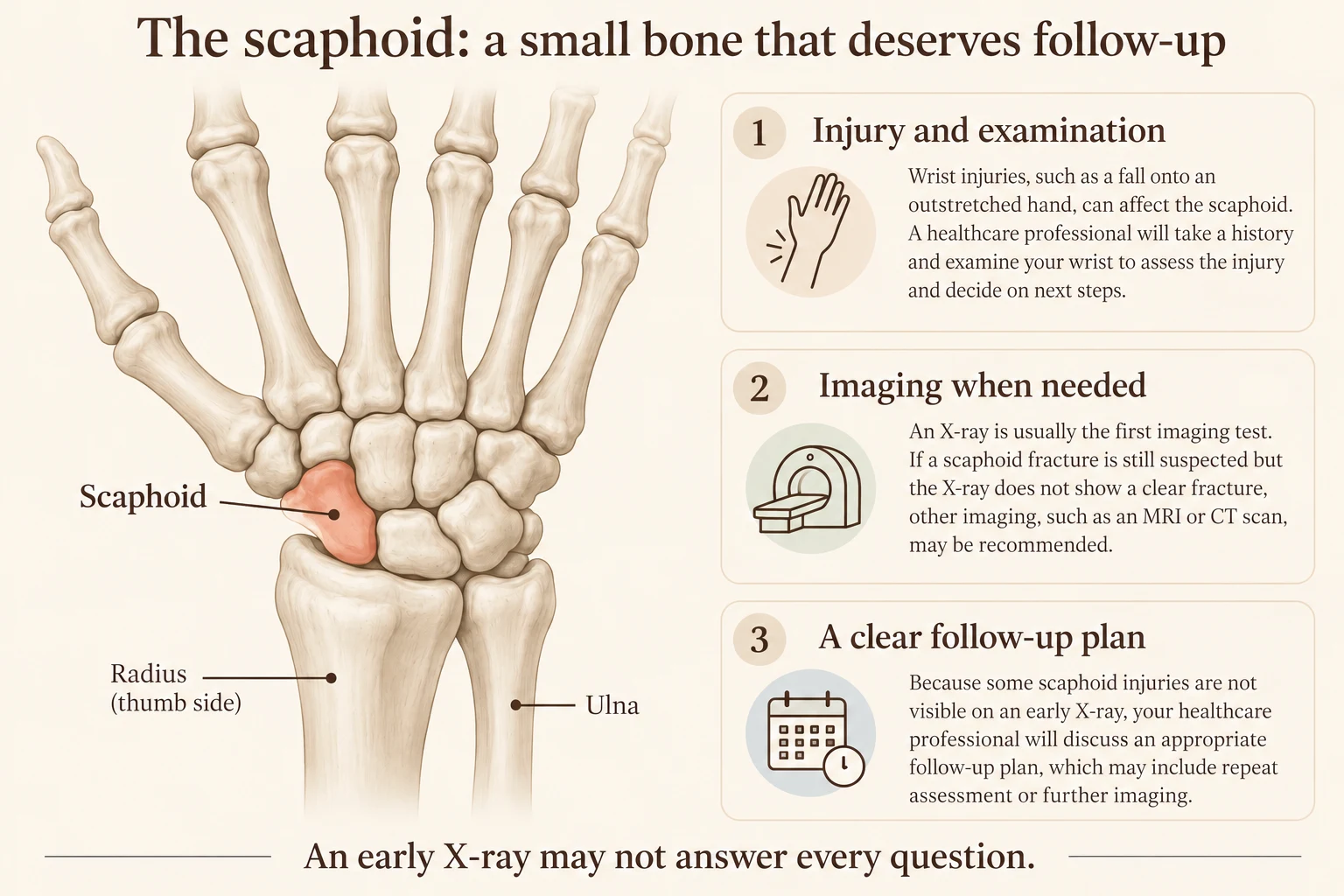
Original educational illustration. A wrist schematic highlights the scaphoid on the thumb side, beside an injury, imaging and follow-up sequence.
An early X-ray may not settle whether the scaphoid is injured. After an injury and examination, the clinician may recommend additional or repeat imaging and a protection and follow-up plan. The scaphoid is a wrist bone, distinct from the distal radius.
Illustration references: Reference 1 · Reference 2
1. Could a fracture be hidden on the first images?
The scaphoid is a small wrist bone near the base of the thumb. A fracture may not be visible on the first X-rays, so the examination and the story of the fall remain important. Tell the clinician exactly where the pain is and which activities bring it on. A report that says no fracture was seen does not automatically answer every injury question. Ask whether the current findings make a scaphoid injury likely enough to require protection, further imaging, or another assessment. Keep the original report and images available for that discussion.
Sources: Scaphoid Fracture · Scaphoid Fracture: Causes, Diagnosis and Treatment
2. What should happen while the diagnosis is uncertain?
Ask for explicit instructions about the splint or other protection recommended for you. Clarify which hand activities are restricted, whether the device can be removed, and whom to contact if it causes a problem. Do not use improving pain as your own clearance to resume loading the wrist. Explain if your work involves lifting, gripping tools, or supporting your body through the hand. Those details help the team plan a realistic period of protection. Arrange the follow-up before leaving whenever possible, so an uncertain diagnosis does not become an indefinite wait without a plan.
If you were sent home with protection but no definite follow-up, contact the treating service to clarify the next appointment. Write down whether the plan is to reassess the examination, repeat imaging, or obtain another study. These are active steps in resolving the injury question, not evidence that the first clinician was necessarily wrong or that the wrist must be broken.
Sources: Scaphoid Fracture · Scaphoid Fracture: Causes, Diagnosis and Treatment
3. Which follow-up test would answer the next question?
Depending on the circumstances, the clinician may discuss repeat radiographs or advanced imaging such as MRI or CT. Ask what each proposed study would establish and how the answer would change care. A test that detects an injury and one that helps characterize healing may serve different purposes. Tell the office where the first images were taken and confirm that the actual files can be reviewed. If scheduling creates a delay, ask whether the protection plan or review date should change. Avoid substituting a generic imaging timetable for the treating team's instructions.
4. If a fracture is confirmed, what affects the treatment choice?
Ask the clinician to show the location and explain the alignment of the fracture. The scaphoid's blood supply and the features of the injury can influence healing and the choice between immobilization and surgery. Your health, activity demands, and the time since injury also belong in the discussion. Ask which feature matters most in your case rather than comparing yourself with someone who had a different wrist fracture. If an operation is suggested, discuss the goal, alternatives, recovery commitments, and what uncertainty remains even after the bone is stabilized.
Sources: Scaphoid Fracture · Scaphoid Fracture: Causes, Diagnosis and Treatment
5. How will we know it is healing enough for more activity?
Less pain and a healed fracture are related but different questions. Ask how the clinician will assess healing and which finding would permit a change in loading, splint use, or rehabilitation. Give specific examples: pushing up from a chair, carrying groceries, using a wrench, or returning to a sport. The answer may differ for each task. If your job requires a written restriction, ask for it before attempting the work. Keep therapy instructions linked to the latest surgical or fracture follow-up rather than assuming an earlier plan still applies.
Sources: Scaphoid Fracture · Scaphoid Fracture: Causes, Diagnosis and Treatment
6. What if discomfort persists or the original injury was missed?
Explain the full timeline, including any period when you resumed normal activity because the first assessment seemed reassuring. That history is useful information, not something to be embarrassed about. Ask whether persistent pain changes the concern about healing or another wrist injury. If a longstanding fracture problem is found, the treatment discussion may differ from that for a recent injury. Leave with a definite next step and a contact route for worsening symptoms or splint problems. A careful follow-up plan is more helpful than either dismissing the pain or assuming that surgery is inevitable.
Sources: Scaphoid Fracture · Scaphoid Fracture: Causes, Diagnosis and Treatment
Make the most of your visit
Questions to bring to your consultation
Choose the questions that matter most to you. Bring them along, and ask us to explain anything that is unclear.
- Does the examination still suggest a scaphoid injury despite the first X-ray?
- What protection should I use while we clarify the diagnosis?
- Which follow-up image would change the plan?
- What fracture feature most affects healing in my case?
- How will you decide when loading the hand is safe?
- What should I do if follow-up imaging cannot be arranged on time?
Sources & further reading
- Scaphoid FractureAmerican Society for Surgery of the Hand (ASSH / The Hand Society)
- Scaphoid Fracture: Causes, Diagnosis and TreatmentHospital for Special Surgery
We use these medical sources to help explain your options and prepare you for a conversation with our team. Our guides feature our own clinicians; patient reviews describe individual experiences.