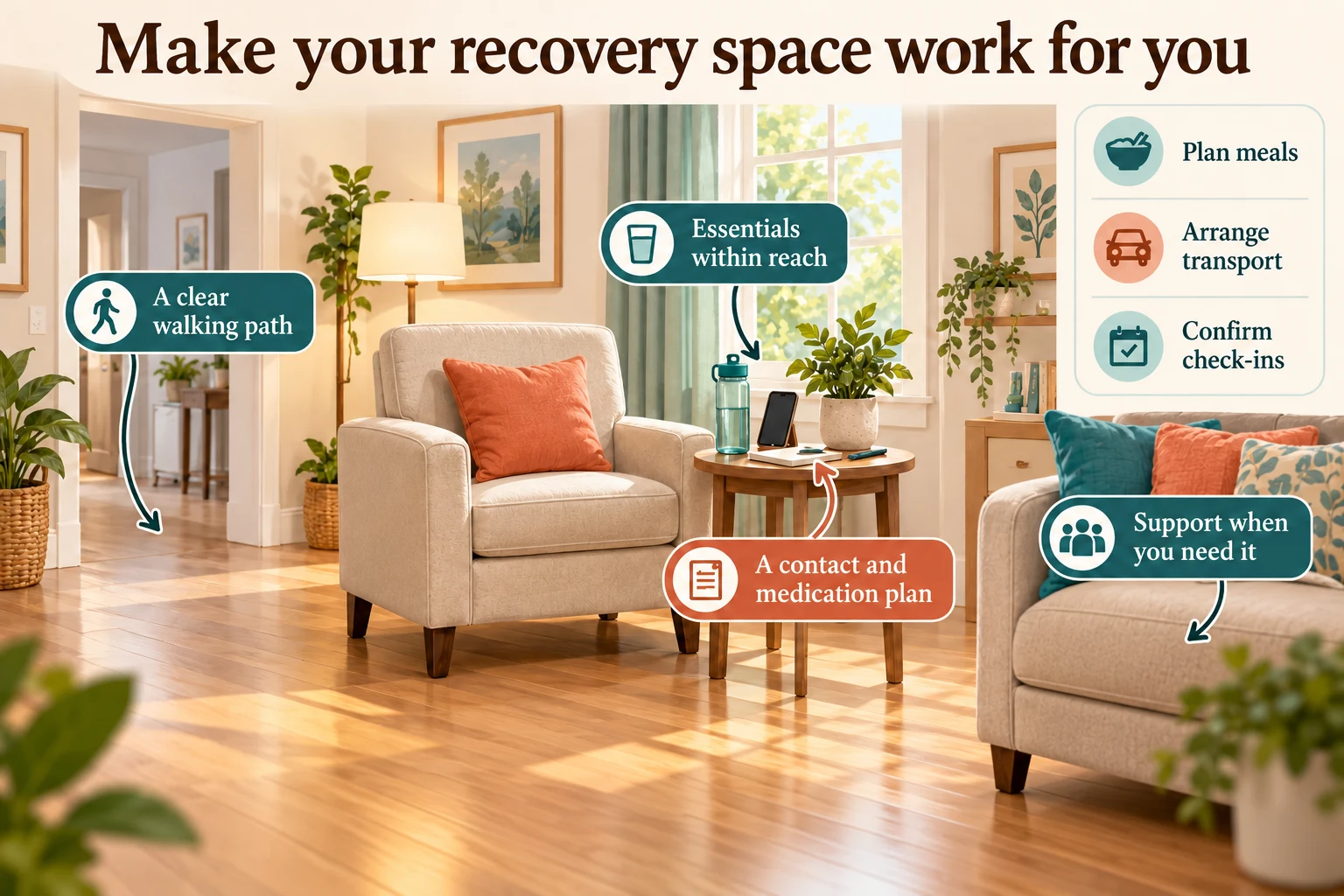
Original educational illustration. An illustrated living area shows a clear walking path, firm chair, nearby phone, water and written plan.
Arrange meals, transport and check-ins. Keep essentials within reach and agree on a contact and medication plan. The room is an illustration; a discharge assessment must consider your own mobility, restrictions and available support.
Illustration references: Reference 1 · Reference 2
1. Confirm that this pathway fits your health
AAHKS emphasizes patient selection, education and a coordinated team for outpatient joint replacement. Ask which features of your medical history affect the recommendation and whether additional assessment is needed. Mention sleep apnea, heart or lung disease, diabetes, prior anesthesia problems and previous difficulty controlling pain or nausea. A successful plan can include an overnight stay when appropriate. Ask how the team will decide, and avoid treating discharge on a particular day as the measure of a good result.
Sources: Outpatient Joint Replacement: 2024 Position Statement
2. Know the discharge checks
Ask what you need to demonstrate before leaving: safe transfers and mobility, a workable pain plan, and the other checks required by your surgical team. These are assessments to complete, not milestones to rush through because a ride is waiting. Find out who makes the final decision and how the plan changes if one requirement is not met. Share any concern honestly, including dizziness, nausea or feeling unsure about using the walking aid.
Sources: Outpatient Joint Replacement: 2024 Position Statement
3. Arrange a responsible person for the required period
Ask exactly how long someone needs to stay with you and what help they must provide. A person who can collect you is not necessarily available to help with meals, medicines, toileting or an unexpected problem later. Discuss the arrangement before surgery and let the team know if it is not feasible. If you live alone, request help planning alternatives rather than assuming a few phone calls provide the same support.
Sources: Outpatient Joint Replacement: 2024 Position Statement
4. Rehearse the route into your home
Describe steps, railings, narrow spaces, bathroom access and where you plan to sleep. Ask which walking aid is appropriate and practice the permitted technique with a professional. Moving a rug or putting essentials within reach may be simple; a steep staircase or very low seat may require more planning. Take photos if useful for the discussion. Your instructions should reflect the home you have, rather than an ideal layout that is unavailable to you.
5. Have medicines and instructions ready
Clarify how prescriptions will be obtained and who will review the schedule with you and your support person. Ask about pain treatment, any prescribed clot-prevention medicine, nausea management and the medicines you normally take. Do not combine or stop treatments without instructions. Keep a current written list and one place to record doses if the team recommends it. Make sure the plan is readable and realistic for the person helping after anesthesia.
Sources: Outpatient Joint Replacement: 2024 Position Statement
6. Plan food, fluids and everyday help
Ask what eating and drinking instructions apply after surgery and what to do if nausea makes them difficult to follow. Arrange accessible meals, shopping and help with pets or dependents. Consider how you will carry items while using a walking aid. A practical recovery plan includes the ordinary tasks that fill a day, not just exercise appointments. Tell the team about responsibilities that cannot simply be paused and identify who can take them over.
7. Confirm the first rehabilitation steps
Find out whether therapy begins at home, in a clinic or through another arrangement, and who schedules it. Ask which instructions apply before the first appointment and how the therapist receives the operation details. Do not substitute an online routine for your plan. Clarify who can change restrictions and how to report a movement that seems unsafe. The first appointment should build on a shared plan rather than begin with uncertainty about what occurred in surgery.
8. Keep an after-hours contact plan
Save the surgical team's numbers and distinguish routine questions from symptoms needing urgent assessment. Ask what changes in the wound, pain, swelling or movement should trigger a call. Chest pain, sudden breathlessness or other emergency symptoms require emergency services, not a portal message. Your support person should know where these instructions are kept. Ask how the team follows up after discharge and what to do if you miss the expected contact.
Sources: Outpatient Joint Replacement: 2024 Position Statement
9. Know the backup plan
Discuss what happens if you need to stay longer, cannot manage the home setup or develop a problem after leaving. Confirm transport, follow-up and any insurance arrangements without assuming that approval for the operation covers every possible service. We encourage you to raise practical obstacles early. Same-day discharge works best as a flexible clinical decision, supported by preparation and reassessment, rather than a promise that overrides how you are actually doing.
Sources: Outpatient Joint Replacement: 2024 Position Statement
Make the most of your visit
Questions to bring to your consultation
Choose the questions that matter most to you. Bring them along, and ask us to explain anything that is unclear.
- Why is same-day discharge appropriate for my health and procedure?
- What must I demonstrate before going home?
- How long must a responsible adult stay with me?
- Can we review my stairs and bathroom setup?
- How will I obtain and organize the prescribed medicines?
- Who arranges the first rehabilitation visit?
- What is the after-hours contact and emergency plan?
- What happens if I need an overnight stay?
Sources & further reading
- Outpatient Joint Replacement: 2024 Position StatementAAHKS · Published 2024
- Surgery-Specific Rehabilitation GuidesHospital for Special Surgery
We use these medical sources to help explain your options and prepare you for a conversation with our team. Our guides feature our own clinicians; patient reviews describe individual experiences.