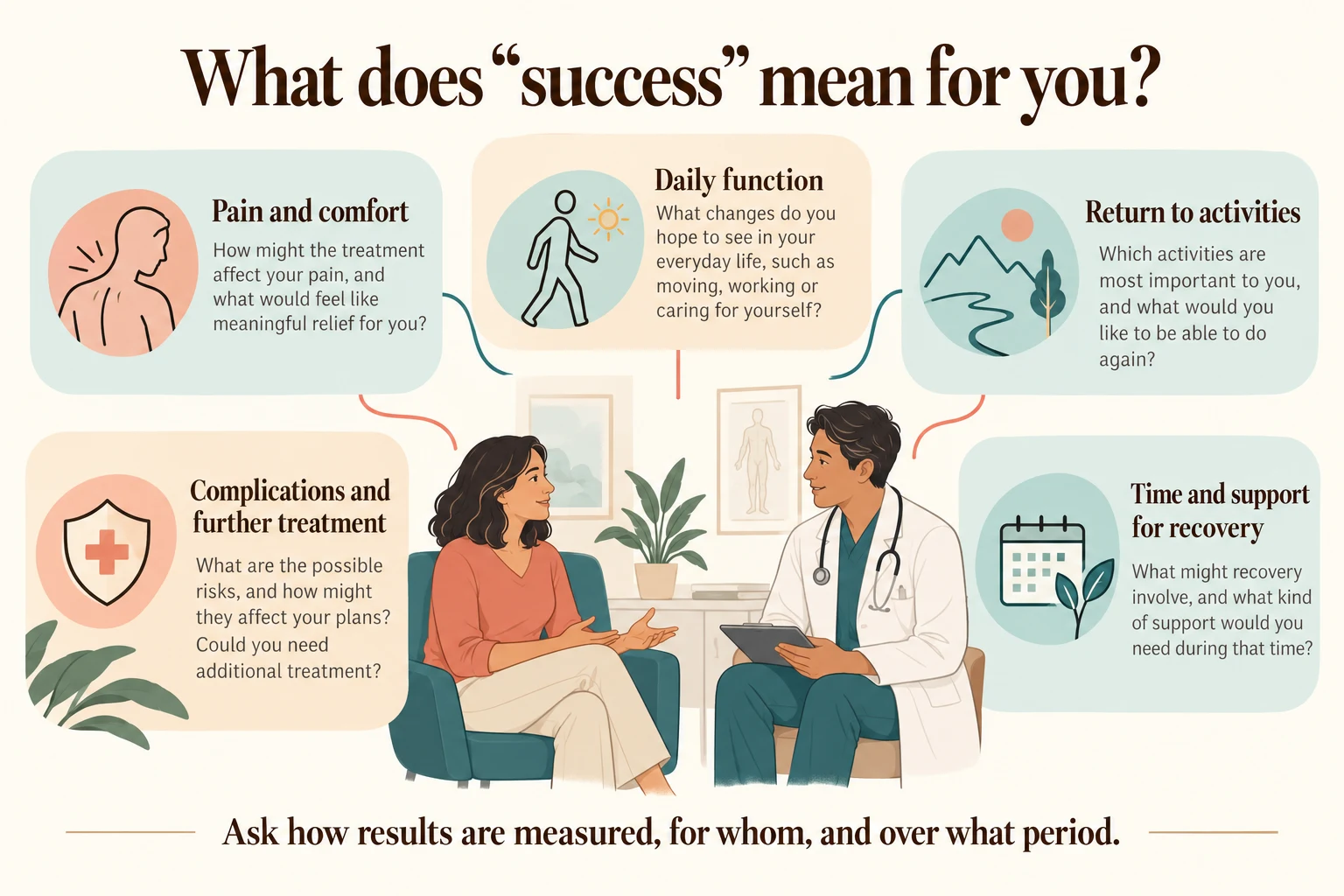
Original educational illustration. Five discussion areas surround an illustrated patient-clinician conversation: comfort, function, activities, complications and recovery support.
Ask how results are measured, in which patients and over what period. Pain relief, daily function, returning to activities, further treatment and time or support needs are separate outcomes. Patient reviews alone cannot establish their probabilities.
Illustration references: Reference 1 · Reference 2
1. Ask what success actually means
The word may refer to less pain, improved function, a healed repair, return to sport, avoiding another operation or satisfaction with care. These are different outcomes. Ask which one the quoted figure measures and whether it reflects the task you want to regain. A person can be satisfied with communication while still having a limitation, or improve a symptom without returning to a demanding job. Start by defining the result that matters to you before comparing percentages.
Sources: AHRQ — Patient-Reported Measures
2. Find out who was included
Ask whether the patients had the same diagnosis, severity and type of operation as you. Age, prior surgery, associated injuries and health conditions can affect how relevant a study is. A figure from selected athletes may not describe someone with advanced arthritis, and a primary operation is different from a revision. Request the source of the number and an explanation of which features of your case make it more or less applicable. Similar procedure names do not guarantee comparable patients.
Sources: American College of Surgeons — Questions Before an Operation
3. Check the time point
A result measured shortly after surgery answers a different question from one measured years later. Ask when the outcome was assessed and whether the benefit, complications or need for further treatment changed over time. If the main concern is long-term function or implant durability, an early satisfaction score is incomplete. Conversely, a long-term study may not explain the practical burden of the first recovery phase. Ask for both views where they matter to your decision.
4. Ask what happened to people missing from follow-up
Find out whether the result includes everyone treated or only those who completed a questionnaire or returned for assessment. Missing data can make interpretation less certain, especially if people with poor or excellent outcomes respond differently. You do not need to calculate an adjusted estimate yourself. Ask the clinician how much confidence the available follow-up supports and whether the report clearly describes the people who were not reassessed. An honest explanation of uncertainty is more useful than an unexplained precise number.
5. Look at harms and further treatment too
A benefit figure should be considered alongside complications, additional procedures and persistent symptoms. Ask whether another operation counts as a failure and what smaller interventions are excluded from that definition. Also ask what recovery the patients completed to reach the result. If a comparison shows an advantage, request the absolute difference in terms you can understand rather than relying only on a relative percentage. Discuss how the risks change with your health and the specific operation proposed.
Sources: American College of Surgeons — Questions Before an Operation
6. Separate reviews from outcome measurement
Patient-experience measures ask about care processes such as communication, while patient-reported outcome measures assess health or function from the patient's perspective. AHRQ explains that these tools serve different purposes. Reviews can offer valuable personal accounts but are not a controlled comparison or a complete denominator of everyone treated. Use them to generate consultation questions about support, explanations and follow-up. Do not treat the average star rating as a probability that a tendon will heal or that you will achieve a particular sporting goal.
Sources: AHRQ — Patient-Reported Measures
7. Bring the number back to your decision
Ask the surgeon to explain a realistic range of possibilities for your situation, including the option of not having surgery now. Tell our team which outcome would make the recovery worthwhile and which limitation would be difficult to accept. If a result is uncertain, ask what information could narrow that uncertainty. A useful consultation connects the research, the clinician's experience and your priorities without claiming that any one statistic predicts your future. Leave knowing what the number adds and what it cannot answer. Bring the source of any number you want to discuss, not just the percentage.
Sources: American College of Surgeons — Questions Before an Operation
Make the most of your visit
Questions to bring to your consultation
Choose the questions that matter most to you. Bring them along, and ask us to explain anything that is unclear.
- What exact outcome does this success rate measure?
- Were the patients comparable to me?
- At what follow-up time was it measured?
- How many treated patients were missing from follow-up?
- What complications or additional treatments were counted?
- How does the number differ from a review or satisfaction score?
- What does the evidence suggest for my own goals and alternatives?
Sources & further reading
- AHRQ — Patient-Reported MeasuresAgency for Healthcare Research and Quality
- American College of Surgeons — Questions Before an OperationAmerican College of Surgeons
We use these medical sources to help explain your options and prepare you for a conversation with our team. Our guides feature our own clinicians; patient reviews describe individual experiences.