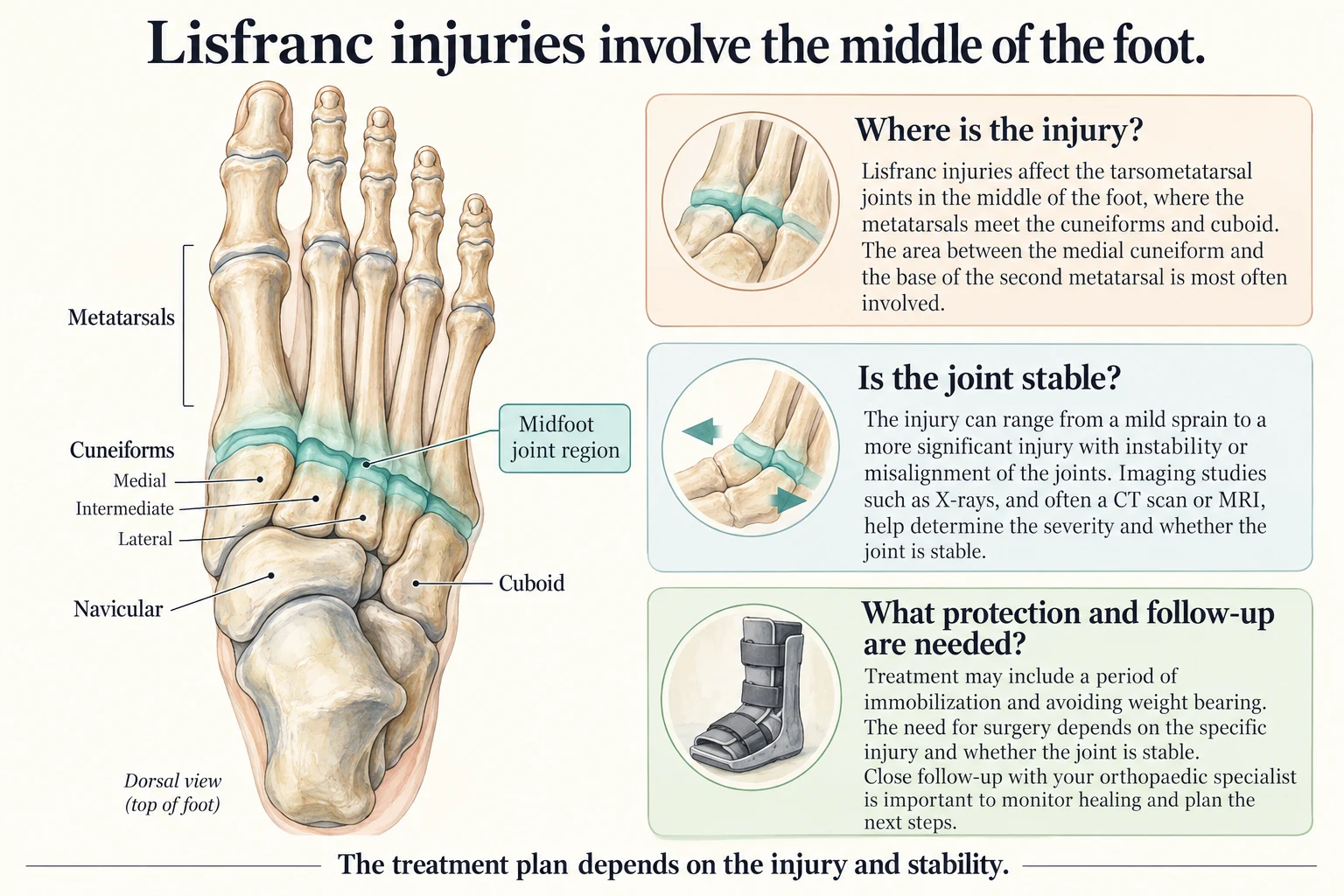
Original educational illustration. A top-view foot schematic highlights the joints where the metatarsal bases meet the midfoot bones.
Ask where the injury is, whether the joints are stable, and what protection and follow-up are needed. These injuries range in severity; imaging and clinical assessment guide care. The picture does not demonstrate a self-test.
Illustration references: Reference 1 · Reference 2

Original educational illustration. Illustrated scenes show device fitting, home access, stairs and transport planning, and discussion with a care team.
Choose and practice a plan that matches your weight-bearing instructions, balance and home. Discuss the device, doorways, stairs and travel before discharge. The people shown are fictional; no walking or stair technique is prescribed.
Illustration references: Reference 1 · Reference 2
1. Which part of the midfoot is injured?
The Lisfranc region connects the long bones of the forefoot with the midfoot. Injury can disrupt the support that makes this area useful for standing and push-off. Describe the accident, whether the foot was twisted or compressed, and any bruising or difficulty bearing weight. Ask the clinician to show you the structures involved. An injury that was first called a sprain may still need further assessment if symptoms or examination findings remain concerning. Do not assume that a modest-looking accident excludes an important midfoot injury.
Sources: Lisfranc Injury · Lisfranc (Midfoot) Injury
2. Is the alignment stable?
Ask whether the bones remain in an acceptable relationship and whether the supporting ligaments can maintain that relationship. Stability helps guide the discussion of protection or surgery. Explain any change in pain, swelling, or ability to walk since the first assessment. The clinician may use examination and imaging to answer the stability question; you should not repeatedly load or twist the foot to test it yourself. If the answer remains uncertain, leave with a plan that protects the foot while the next assessment is arranged.
Sources: Lisfranc Injury · Lisfranc (Midfoot) Injury
3. What imaging is needed to make the decision?
Ask what the current images show and what remains unclear. Depending on the situation, the team may discuss additional views or advanced imaging. If weightbearing images are considered, that should be a supervised clinical decision, not an instruction to stand on a painful foot at home. Bring previous studies so the clinician can compare them. Clarify whether an imaging result could change the treatment recommendation and who will explain it. An arranged review date helps prevent a potentially important injury from being lost between appointments.
Sources: Lisfranc Injury · Lisfranc (Midfoot) Injury
4. Why is nonsurgical protection or surgery recommended?
Ask which finding makes the proposed route suitable for you. If protection is recommended, discuss how the team will ensure that alignment remains acceptable. If surgery is proposed, ask which structures would be stabilized or fused and why that choice fits the injury. The name Lisfranc surgery can cover different operations. Discuss important risks and the possibility of later symptoms. Your work, health, and ability to follow restrictions matter, but they should be considered alongside the injury pattern rather than replacing the clinical explanation.
Sources: Lisfranc Injury · Lisfranc (Midfoot) Injury
5. How will I manage the period of restricted loading?
Ask for plain-language instructions about how much weight, if any, is permitted and how the restriction applies during transfers. Discuss an appropriate mobility aid and whether stairs, narrow rooms, or an injured upper limb make its use difficult. Arrange help with shopping, meals, transport, and caregiving. These details are part of deciding whether the treatment plan is workable. If your home situation cannot support the proposed restriction, tell the team before discharge or surgery. Do not improvise a walking plan because an aid is inconvenient.
Confirm that the person helping you understands the same restriction.
Sources: Lisfranc Injury · Lisfranc (Midfoot) Injury
6. What does follow-up need to establish?
Ask when the foot will be reassessed and which findings would allow a change in protection or activity. If hardware is used, discuss whether later removal is expected, optional, or only considered for a particular reason. Keep questions about healing separate from questions about readiness for work or sport. They are connected but not interchangeable. Ask how the surgeon and therapist will share updates. A clear written restriction helps the people supporting your recovery understand the current plan rather than relying on an earlier estimate.
Sources: Lisfranc Injury · Lisfranc (Midfoot) Injury
7. What if pain or stiffness continues later?
Discuss the possibility of longer-term discomfort or arthritis without assuming that either is inevitable. Ask what symptom pattern should prompt reassessment after the initial healing phase and which daily goals will guide rehabilitation. Bring an example of the activity that remains difficult, such as walking on uneven ground or standing through a work shift. If the treatment changes, ask what the new step is intended to accomplish. Recovery should be reviewed against the specific injury and your function, not another patient's calendar or the size of a surgical incision.
Sources: Lisfranc Injury · Lisfranc (Midfoot) Injury
Make the most of your visit
Questions to bring to your consultation
Choose the questions that matter most to you. Bring them along, and ask us to explain anything that is unclear.
- Which bones and ligaments are involved?
- Is the midfoot stable, and how do you know?
- Would another image change treatment?
- Why does the recommended operation or protection plan fit this injury?
- What exactly does my loading restriction mean?
- Which findings will permit more activity?
- What persistent symptoms should lead to another assessment?
Sources & further reading
- Lisfranc InjuryAmerican Orthopaedic Foot & Ankle Society (AOFAS / FootCareMD)
- Lisfranc (Midfoot) InjuryAmerican Academy of Orthopaedic Surgeons (AAOS OrthoInfo)
We use these medical sources to help explain your options and prepare you for a conversation with our team. Our guides feature our own clinicians; patient reviews describe individual experiences.