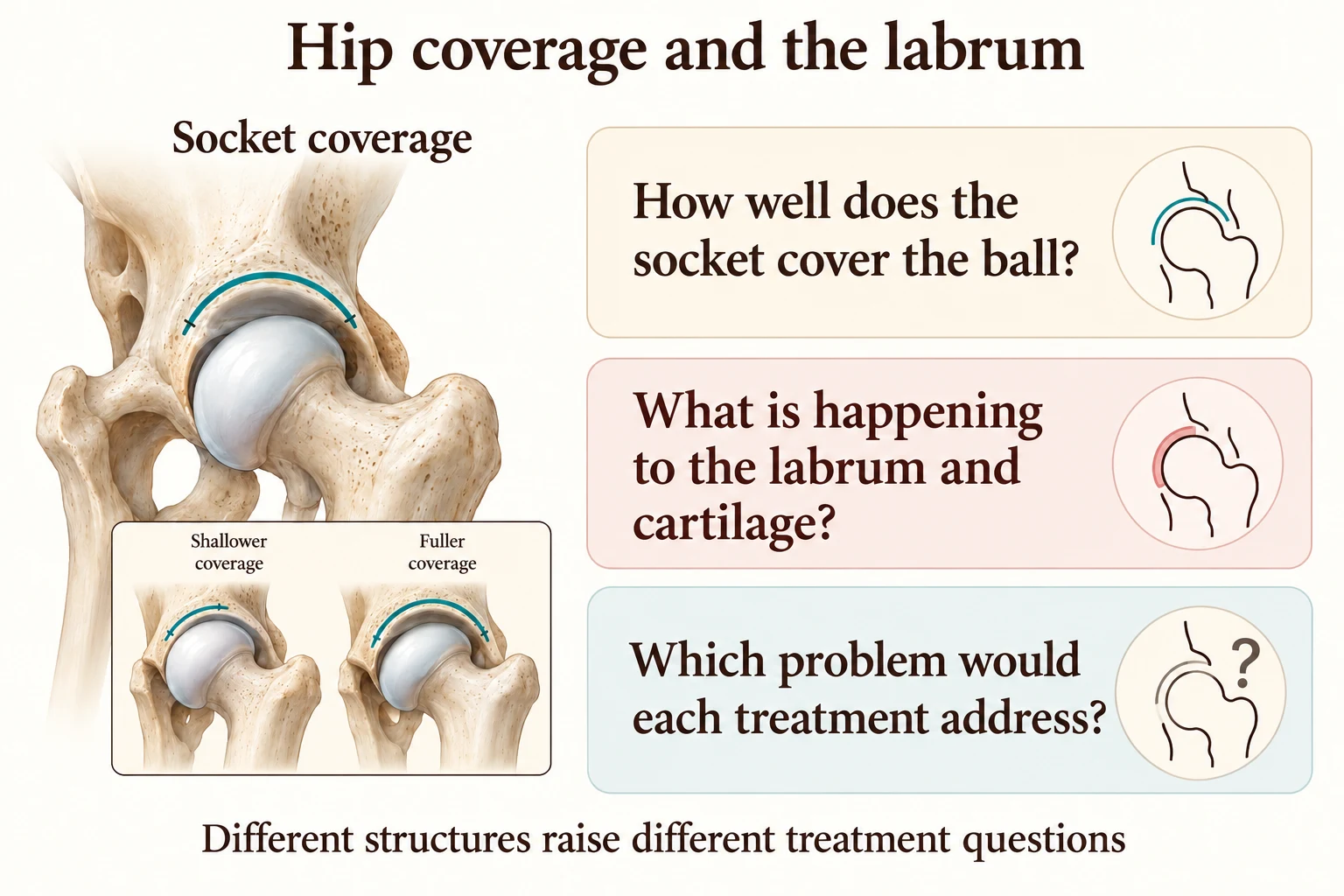
Original educational illustration. A hip socket-coverage schematic sits beside questions about coverage, labrum, cartilage and treatment purpose.
Ask how well the socket covers the ball, what is happening to the labrum and cartilage, and which problem each proposed treatment addresses. The drawings are conceptual, not a plan for an individual operation.
Illustration references: Reference 1 · Reference 2
1. Point to the main location, then describe the spread
Tell the clinician whether the pain is mainly in the groin, side of the hip, buttock or another area, and whether it travels elsewhere. Use your hand to show the region rather than worrying about the correct anatomical term. Hip-joint and surrounding-tissue problems can overlap with symptoms from the back. Ask what the pattern suggests and what it does not establish. A body diagram can help you communicate, but it should not become a self-diagnosis map.
Sources: Hip Conditions
2. Explain how it began
Was there a fall, change in training, unusual movement or gradual onset without a clear event? Note when you first noticed it and what has changed since. If pain follows an injury and you cannot bear weight, seek prompt assessment rather than waiting to complete a diary. Tell the team about prior hip or back surgery and any earlier episode that seemed similar. The story may guide which examination or imaging questions matter most.
Sources: Hip Conditions
3. Name the task that reliably brings it on
Examples might include getting into a car, climbing stairs, sitting for work, turning in bed or standing on one leg. Describe what happens before, during and afterward. Also mention activities you can still do comfortably. A useful assessment connects the complaint to the task, not only to a scan finding. Ask whether the movement pattern points toward the joint, tendons or another contributor and how the clinician will test that possibility safely.
Sources: What Is Gluteal Tendinopathy and Why Is It Common in Women?
4. Mention side-lying and local tenderness
Pain over the outside of the hip, especially with pressure or certain loading activities, can raise questions about gluteal tendons and nearby tissues. It is sometimes described broadly as bursitis, but that label may not capture the whole problem. Ask which structures seem involved and whether tendon strength or a tear needs evaluation. Describe the positions that disturb sleep without repeatedly pressing on the area to test it. The examination should guide treatment rather than location alone.
Sources: What Is Gluteal Tendinopathy and Why Is It Common in Women?
5. Describe nerve-like or back-related symptoms
Mention numbness, tingling, weakness or pain that changes with back position, and say whether these occur with the hip pain or separately. These features may change the evaluation. New major weakness, loss of bladder or bowel control, or numbness around the groin requires urgent assessment. Do not assume all pain near the hip is an orthopedic joint problem. Ask which clinician should coordinate the assessment if findings suggest more than one region is contributing.
Sources: Hip Conditions
6. Bring the effect on daily life
Tell us what has become harder and what you have stopped doing. Walking tolerance, sleep, dressing and work may reveal more about the decision than one pain score. Bring previous treatment details and explain whether relief was meaningful or brief. If you have several painful areas, choose the most limiting problem to discuss first while making sure the others are recorded. Ask which goal will be used to judge whether the first treatment plan is helping.
If symptoms are intermittent, a short note about a typical day may be more helpful than the day you happen to attend the appointment. Include the effect of sitting, walking and sleep, and any treatment used, without repeatedly provoking pain to produce a record.
7. Ask what would clarify the source
An examination may be enough to begin a plan, while selected imaging or an injection may be considered when it answers a specific question. Ask what each proposed test could change and what uncertainty would remain afterward. Avoid assuming that the most detailed scan automatically provides the most useful answer. Our related hip and spine profiles can help you identify an evaluation pathway, but the location of pain does not by itself determine the physician or procedure you need.
Sources: Hip Conditions
Make the most of your visit
Questions to bring to your consultation
Choose the questions that matter most to you. Bring them along, and ask us to explain anything that is unclear.
- Which structures could explain this pattern?
- What does the examination suggest beyond the pain location?
- Could the hip and back both be contributing?
- Does side-lying pain point toward a tendon problem?
- Which symptoms need prompt or urgent assessment?
- What would imaging or an injection change in the plan?
- How will we judge whether treatment is helping my main activity?
Sources & further reading
- Hip ConditionsHospital for Special Surgery
- What Is Gluteal Tendinopathy and Why Is It Common in Women?Hospital for Special Surgery
We use these medical sources to help explain your options and prepare you for a conversation with our team. Our guides feature our own clinicians; patient reviews describe individual experiences.