Understand the problem the operation would address
In hip dysplasia, the socket does not provide enough coverage for the ball of the hip. That can change how forces pass through the joint and place extra demand on the labrum and cartilage. A labral tear may therefore be part of a larger structural problem.
Ask the clinician to show you the relevant features on the images and explain how they connect with your pain. A number in a radiology report is a starting point for discussion, rather than a complete treatment recommendation. Your symptoms, examination and remaining joint health matter too.
Clarify the difference between PAO and arthroscopy
A periacetabular osteotomy, or PAO, repositions the socket by cutting and moving pelvic bone, then holding it while it heals. Arthroscopy works on selected structures within the joint. These procedures address different problems and may sometimes be considered together.
Ask why treating the labrum alone would or would not be enough for your hip. If the recommendation includes an additional femoral procedure, ask what alignment issue it addresses. A diagram can make this far clearer than a sequence of technical names.
Sources: International Hip Dysplasia Institute: Hip Preservation Surgery
Ask what makes preservation worthwhile
The preservation discussion should include cartilage condition, how well the joint surfaces match and whether arthritis changes the expected benefit. Ask what is known from your images and what remains uncertain. Some people need additional imaging to answer a specific planning question.
Compare options in terms of your own priorities. Rehabilitation or activity changes may help symptoms without changing socket coverage. An operation brings a different set of possibilities, restrictions and risks. Ask what the team would monitor if you choose to wait and what would make a new assessment appropriate.
Sources: AAOS OrthoInfo: Adolescent Hip Dysplasia · International Hip Dysplasia Institute: Hip Preservation Surgery
Take the recovery commitment seriously
PAO requires protection of healing bone followed by a substantial rehabilitation process. The timing of crutch progression, walking and sport should come from your treating team. Institutional rehabilitation guidance illustrates why both healing time and functional criteria matter; it is not a schedule that every patient should copy.
Ask how your surgeon and therapist will communicate, which imaging or examination findings permit progression and what support is needed before you can manage ordinary daily tasks independently. Clarify whether another procedure performed at the same time changes the plan.
Sources: Ohio State Sports Medicine: Periacetabular Osteotomy Clinical Practice Guideline
Bring the details that help you decide
Bring prior images and reports, the treatment timeline and a description of the activities that provoke symptoms. Include school, work, stairs, transport and any sport that matters to you. If you have received different recommendations, bring those records too.
Write down your main concern: living with current pain, the recovery burden, preserving the natural joint or uncertainty about later surgery. Ask the clinician to address that concern directly. Before leaving, make sure you understand the options, the reason for the preferred one and what information you still need to make a decision.
Meet our hip preservation specialist
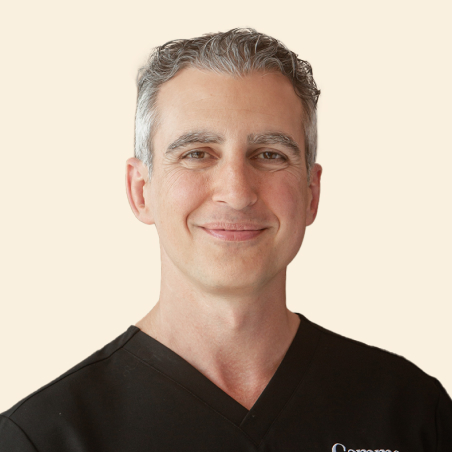
At Commons Clinic, Dr. Tigran Garabekyan focuses on hip preservation, hip dysplasia, labral tears and PAO. His provider page explains that focus in more detail. The patient experiences below offer a view of communication and reassurance during care. Use them alongside a consultation that explains the structure of your hip and the practical demands of each option.
Separate the socket problem from the labral injury
HSS describes how a shallow or misoriented socket can overload the labrum and joint surface. A PAO changes socket orientation; a labral procedure addresses a different part of the problem. If both appear in your recommendation, ask the surgeon to explain the job of each operation on your own images.
This is especially useful after a previous arthroscopy or when you have received different opinions. Ask which source of pain is most likely, how much cartilage remains and whether the proposed correction would leave another mechanical issue unresolved. The goal is a coherent explanation of the whole hip.
Understand why preservation may or may not fit your joint
Johns Hopkins distinguishes hip-preserving surgery for teens and young adults with instability from replacement for some adults who develop severe arthritis. That is a decision about the health and mechanics of the joint, not simply a preference for keeping the original hip at any cost.
Ask what your examination and imaging show about the remaining joint surface and how those findings affect expected benefit. Discuss what the surgeon would recommend if you chose to wait, and what would prompt a different plan. Bring the activities you value so that preserving the joint also has a clear purpose in your life.
Sources: Hip Dysplasia
Make the most of your visit
Questions to bring to your consultation
Choose the questions that matter most to you. Bring them along, and ask us to explain anything that is unclear.
- How does my socket coverage relate to my symptoms?
- What do the images tell us about cartilage health and arthritis?
- What would PAO correct that arthroscopy alone would not?
- Would another hip or femoral procedure be needed, and why?
- What benefit can rehabilitation offer while preserving my options?
- What risks and uncertainties are most relevant to my hip?
- Which healing and strength milestones guide crutch use and sport?
- What support, therapy coverage and time away will I need?
- What problem would the PAO correct that a labral repair alone would leave behind?
- How does the remaining cartilage affect whether preservation is worthwhile?
- If I wait, what findings would lead you to change the recommendation?
Sources & further reading
- AAOS OrthoInfo: Adolescent Hip Dysplasia
- International Hip Dysplasia Institute: Hip Preservation Surgery
- Ohio State Sports Medicine: Periacetabular Osteotomy Clinical Practice Guideline
- PAO Surgery (Periacetabular Osteotomy)Hospital for Special Surgery
- Hip DysplasiaJohns Hopkins Medicine
We use these medical sources to help explain your options and prepare you for a conversation with our team. Our guides feature our own clinicians; patient reviews describe individual experiences.