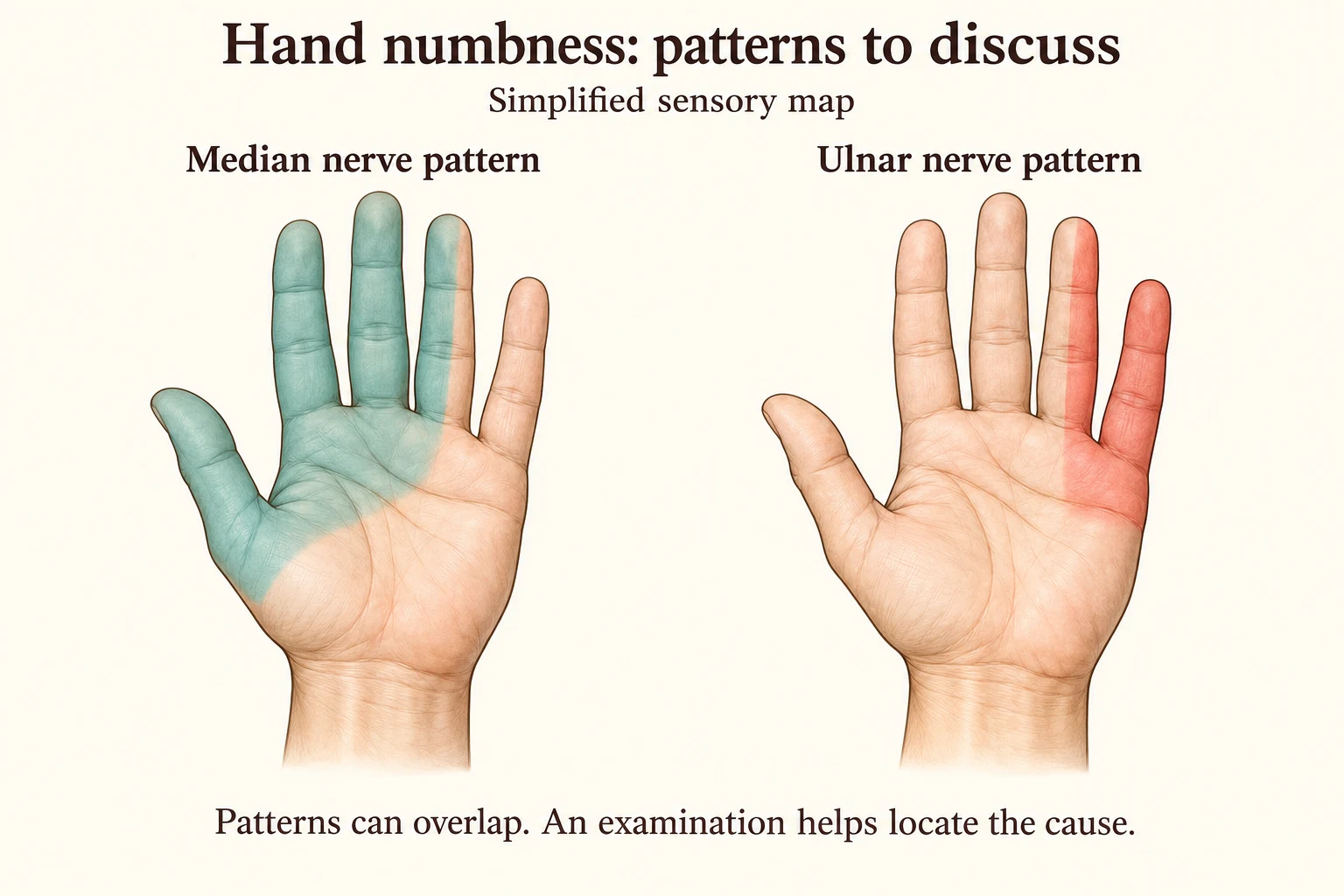
Original educational illustration. Simplified palm maps show common median-nerve and ulnar-nerve sensory areas.
The median pattern includes the thumb, index, middle and thumb-side portion of the ring finger; the ulnar pattern includes the little finger and adjacent portion of the ring finger. Patterns overlap and vary. An examination helps locate the cause.
Illustration references: Reference 1 · Reference 2
1. Which fingers and surfaces are affected?
Before your visit, note where the altered feeling starts and ends. Is it mainly the thumb and nearby fingers, the little finger and adjacent side of the ring finger, the whole hand, or an area that changes? Carpal tunnel involves the median nerve at the wrist; cubital tunnel involves the ulnar nerve around the elbow. These patterns can help guide an examination, but they overlap with other problems. Describe the palm and back of the hand separately if that helps. There is no need to force your symptoms to match an online diagram.
Sources: Carpal Tunnel Syndrome · Cubital Tunnel Syndrome
2. When does the sensation appear?
Write down an ordinary example: waking at night, holding a phone, leaning on an elbow, driving, or using a tool. Include whether a change in position helps and how long that effect lasts. A brief description of several episodes is more useful than repeatedly testing the hand throughout the day. Tell the clinician whether the numbness is becoming more constant. If symptoms occur in both hands, describe each side independently rather than assuming they have the same explanation. Bring the story of when the problem began, including any injury or recent change in work.
Sources: Carpal Tunnel Syndrome · Cubital Tunnel Syndrome
3. Has strength or dexterity changed?
Difficulty fastening a button, dropping a familiar object, or losing confidence with a key can change the urgency and focus of assessment. Explain what you could do before and what you can do now. Avoid measuring strength with a painful home challenge. Report new or progressive weakness promptly rather than waiting to see whether a brace resolves it. The clinician will assess whether the difficulty relates to sensation, muscle function, pain, or another cause. That distinction matters because a treatment aimed at tingling may not explain every problem you notice.
Sources: Cubital Tunnel Syndrome
4. Could the symptoms begin somewhere else?
Mention neck pain, symptoms farther up the arm, previous nerve problems, diabetes, and relevant treatment history. The clinician may need to examine more than the hand. A familiar diagnosis from a friend or an earlier episode is a starting question, not confirmation of today's cause. Ask which findings support the working explanation and which findings do not fit. If more than one problem may be contributing, ask which should be addressed first. This prevents a narrow focus on a single finger from obscuring the larger pattern of your symptoms.
Sources: Carpal Tunnel Syndrome · Cubital Tunnel Syndrome
5. What would a test change?
Ask what uncertainty remains after the history and examination. Nerve-conduction studies, needle EMG, or imaging may be useful in selected circumstances, but they answer different questions. You can ask what a normal result would mean, what an abnormal result might change, and who will explain it. Bring prior reports to avoid reconstructing the testing history from memory. A test is most useful when its purpose is connected to a decision, such as clarifying the nerve involved or assessing another possible source, rather than simply obtaining more information.
Sources: Carpal Tunnel Syndrome · Cubital Tunnel Syndrome
6. What should a first treatment trial accomplish?
If a brace, activity adjustment, or another nonsurgical step is proposed, ask which symptom it targets and how you will judge the response. Discuss the positions and tasks you cannot avoid at work or while caring for someone. Ask for an individualized plan instead of trying several internet remedies together; otherwise, it becomes difficult to tell what helped. Write down the review point and the reason to contact the team sooner. Continuing a trial should be an active decision based on your symptoms and function.
Sources: Carpal Tunnel Syndrome · Cubital Tunnel Syndrome
7. What needs prompt attention, and what happens next?
Know how to report worsening sensation, a new loss of function, or symptoms that no longer follow the earlier pattern. Sudden numbness with facial changes, speech difficulty, or other acute neurologic symptoms needs emergency assessment, rather than a routine hand appointment. For ongoing hand symptoms, leave knowing the next action and the responsible clinician. Bring your symptom notes to follow-up and compare the same daily tasks. The aim is a clearer explanation and a practical plan, not a perfect match between your hand and a colored nerve illustration.
Sources: Carpal Tunnel Syndrome · Cubital Tunnel Syndrome · Mayo Clinic Q and A: When to worry about numbness and tingling
What nerve-conduction studies and EMG can clarify
Nerve-conduction studies and needle electromyography, or EMG, provide different information. A nerve-conduction study uses surface electrodes and electrical stimulation to assess how selected nerves carry signals. Needle EMG records electrical activity in selected muscles. The tests may be performed together, but not every person with hand tingling needs both. Ask which uncertainty remains after the history and examination and how the study is expected to help resolve it.
Tell the testing team about implanted devices, relevant medicines, bleeding concerns, and previous testing. Follow its preparation instructions rather than stopping medication on your own. Ask what sensations to expect, how long the appointment is likely to take, and whether you can return to your usual activities afterward. If a previous study is available, bring the report so the clinician can decide whether comparison or repeat testing adds useful information.
The result needs clinical interpretation. It may help localize a nerve problem or characterize its effects, but a normal study does not exclude every possible cause of altered sensation. Some disorders involving small sensory fibers require different assessment. That limitation is a reason to discuss the result with the clinician, not to self-diagnose another condition. Ask what a normal or abnormal finding would change about the treatment choices being considered.
Before the appointment, identify who will receive the report and who will explain the next step. A result posted in a portal is not the same as a conversation about how it fits your symptoms. Bring the task that remains difficult, any change in strength, and the pattern of numbness to follow-up. The useful outcome is a clearer decision about care, not simply a label or waveform without an explanation you can apply to your situation.
Sources: Nerve Conduction Studies · Electromyography (EMG) · Small Fiber Sensory Neuropathy
Make the most of your visit
Questions to bring to your consultation
Choose the questions that matter most to you. Bring them along, and ask us to explain anything that is unclear.
- Which findings support the nerve problem you suspect?
- Is the weakness I notice part of the same problem?
- Should my neck or another nerve location be assessed?
- What would nerve testing change about treatment?
- Which daily positions should we discuss modifying?
- How will we measure a useful response to the first treatment?
- Which changes should make me contact you sooner?
- What question will testing answer that the examination has not?
- What preparation and personal history does the testing team need?
- How would a normal or abnormal result change my care plan?
Sources & further reading
- Carpal Tunnel SyndromeAmerican Society for Surgery of the Hand (ASSH / The Hand Society)
- Cubital Tunnel SyndromeAmerican Society for Surgery of the Hand (ASSH / The Hand Society)
- Mayo Clinic Q and A: When to worry about numbness and tinglingMayo Clinic
- Nerve Conduction StudiesJohns Hopkins Medicine
- Electromyography (EMG)Mayo Clinic
- Small Fiber Sensory NeuropathyJohns Hopkins Peripheral Nerve Center
We use these medical sources to help explain your options and prepare you for a conversation with our team. Our guides feature our own clinicians; patient reviews describe individual experiences.