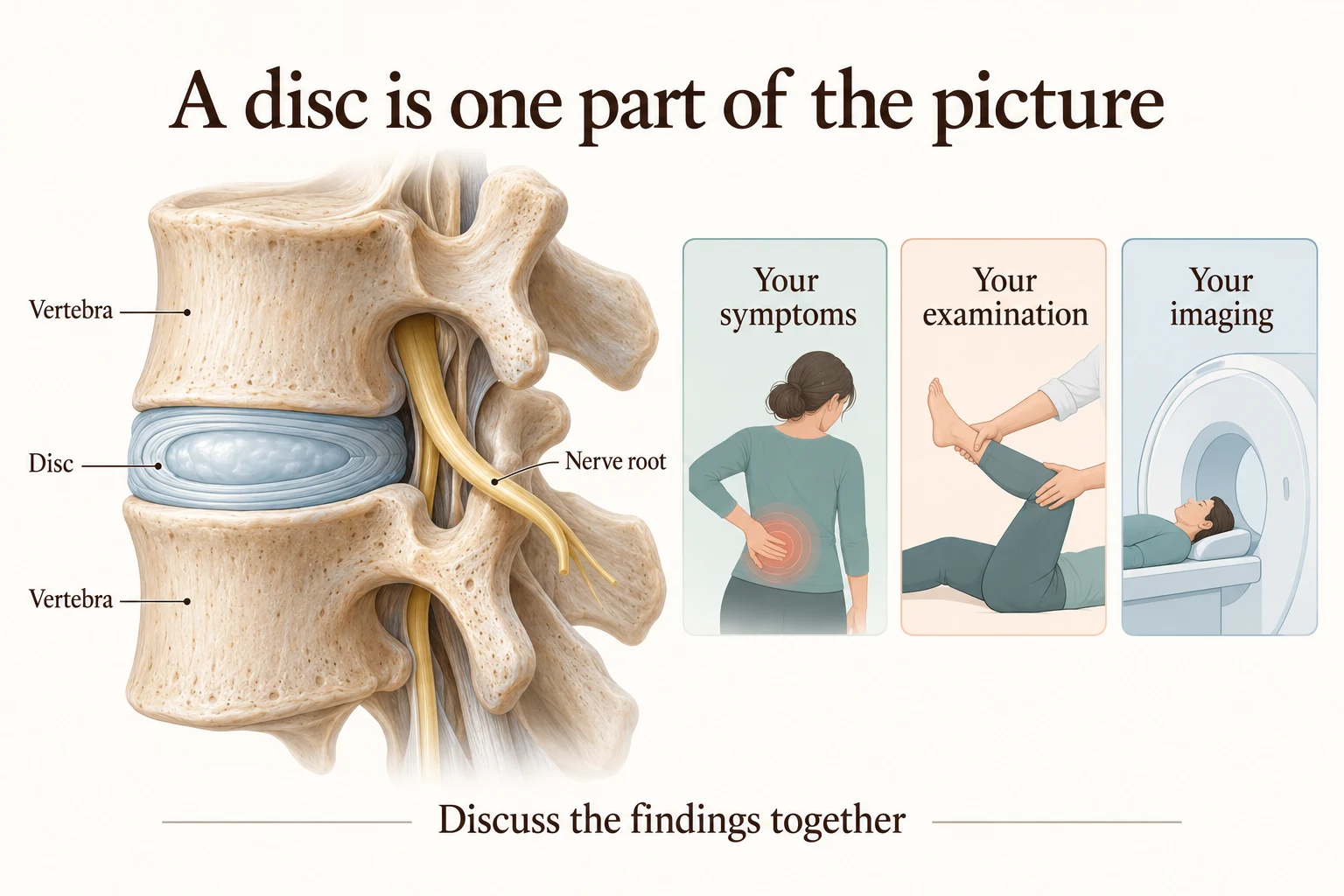
Original educational illustration. A simplified vertebra, disc and nerve illustration alongside symptoms, examination and imaging.
Disc findings are one part of the assessment. Ask which findings fit your symptoms and which activities you want the treatment plan to help you regain.
Illustration references: Reference 1 · Reference 2
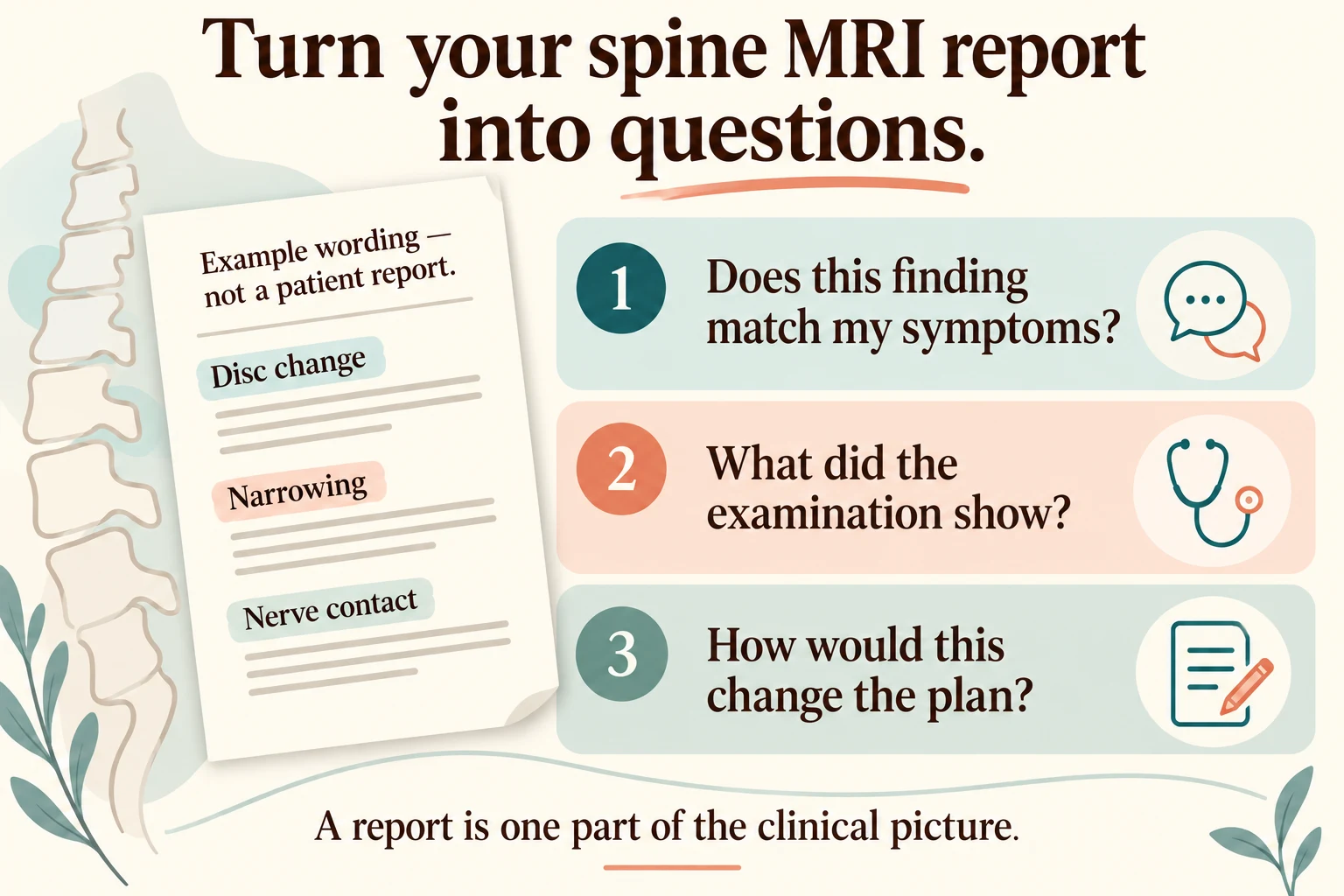
Original educational illustration. A clearly fictional report with disc change, narrowing and nerve-contact wording sits beside three consultation questions.
Ask whether a finding matches your symptoms, what the examination showed, and how it would change the plan. The example is not a patient report or a diagnostic image.
Illustration references: Reference 1 · Reference 2 · Reference 3
1. What does the diagnosis explain about my symptoms?
Degenerative disc disease describes changes in spinal discs, but the words on a scan do not measure how much pain you should have. Degenerative changes can exist without symptoms. Start by asking your clinician which finding fits your history and examination, and which findings may be unrelated to your main concern.
Be specific about location. A neck problem at C5–C6 raises different questions from a low-back problem. Describe pain that travels into an arm or leg separately from local soreness. Ask the clinician to show the relevant level and explain how confidently it accounts for what you feel. An honest answer can include uncertainty and a plan to investigate it.
Sources: Degenerative Disc Disease
2. Which everyday activities should I change, and for how long?
A useful activity discussion begins with your day, rather than a permanent list of forbidden movements. Tell the clinician about lifting at work, carrying children, long drives, gardening, gym training, and the positions you find difficult. Ask which tasks need temporary changes and whether changing the load, duration, or frequency would help you keep participating.
Bring one concrete example: “I can drive for twenty minutes before my arm starts tingling,” or “I avoid grocery shopping because standing becomes difficult.” These are examples of information to share, not diagnostic tests. Ask what to do if the activity brings on your familiar symptoms and what would count as a meaningful change requiring a call.
Sources: Low Back Pain
3. What should an exercise plan help me do?
NIAMS includes individualized physical therapy and a gradual return to tolerated activity among back-pain care options. That is a starting point for a conversation, rather than an exercise prescription for every disc finding. Ask your clinician or physical therapist to connect the plan with an activity you want to regain.
If exercise has been uncomfortable, describe what happened during it and afterward. Ask to review technique, the amount being attempted, and possible alternatives. Request a short written plan explaining the purpose of each exercise and how progression will be decided. The goal might be tolerating a work shift, walking with family, or feeling more confident moving; identify which matters most to you.
4. How can we make work, sleep, and home responsibilities manageable?
Pain advice is easier to use when it accounts for responsibilities you cannot simply stop. Bring your shift length, commute, available breaks, caregiving duties, and sleep concerns into the appointment. If you need work restrictions or an accommodation letter, ask what the clinician can document and when the arrangement should be reassessed.
You do not need to buy a particular chair, mattress, or device before discussing the problem. Describe what you have tried and whether it changed comfort or function. Ask which practical adjustment is worth testing first and how you will judge it. A plan you can follow consistently is more useful than a long shopping list with no clear purpose.
Sources: Degenerative Disc Disease
5. What should we measure besides pain?
Choose a small set of observations that reflect your life. You might record how long a necessary task takes, how often you stop during a walk, or whether symptoms interrupt sleep. Keep the conditions reasonably comparable and avoid turning tracking into a daily test of your limits.
Bring a brief treatment timeline as well: what you tried, why you stopped, and whether the benefit lasted. Ask what degree of progress would justify continuing and when the team wants to hear about a plateau. If pain varies but a valued activity becomes easier, discuss that difference. If pain eases while weakness or function worsens, tell the clinician rather than treating the pain score as the entire result.
Sources: Degenerative Disc Disease
6. When would another treatment or opinion be useful?
An MRI showing disc degeneration does not, by itself, tell you to have an injection, replacement, or fusion. AAOS describes several possible sources of low-back pain and emphasizes matching treatment to the problem. Ask what a proposed next step would address, which symptom it is least likely to change, and why the timing makes sense.
If an elective operation has been suggested, request a comparison with the realistic alternatives using the same goals and tradeoffs. A second opinion can focus on the uncertain point: the diagnosis, whether surgery is indicated, or which levels require treatment. Bring the actual images and earlier recommendation so the discussion can be specific instead of starting from a procedure name.
Sources: Low Back Pain
7. Which changes should bring me back sooner?
Before leaving, agree on a follow-up plan and ask what should prompt earlier contact. Disc changes are only part of the assessment; new symptoms deserve attention in their own right. Ask how to reach the team if you develop new weakness, worsening balance, or a different pattern of arm or leg symptoms.
New loss of bowel or bladder control or numbness around the groin or saddle area can signal an emergency and needs immediate assessment. For the ordinary course of care, write down the next appointment, your main functional goal, and the one or two uncertainties you still want resolved. That gives the next discussion a useful starting point without expecting you to interpret the scan yourself.
Our spine and pain clinicians can help connect the findings with the problem you want addressed. Explore the profiles of Dr. Hyun Bae, Dr. Sanjay Khurana, Dr. Amandeep Bhalla, and Dr. Evish Kamrava, then bring your images and your everyday priorities. Patient reviews can offer a sense of explanations and support people experienced during care.
Sources: Herniated Disc
Make the most of your visit
Questions to bring to your consultation
Choose the questions that matter most to you. Bring them along, and ask us to explain anything that is unclear.
- Which disc finding fits my symptoms, and what may be incidental?
- Are my neck and low-back concerns separate problems?
- Which activities need a temporary adjustment, and when should we review that?
- What should I do if a particular exercise aggravates symptoms?
- What useful change should we track at home or work?
- What is the purpose of the proposed injection or operation?
- Would another opinion help resolve a specific uncertainty?
- Which new symptoms need urgent assessment?
Sources & further reading
- Degenerative Disc DiseaseJohns Hopkins Medicine
- Low Back PainAmerican Academy of Orthopaedic Surgeons
- Back Pain: Diagnosis, Treatment, and Steps to TakeNIH / NIAMS
- Herniated DiscAmerican Association of Neurological Surgeons
- Read our related clinical guide on Commons Clinic ↗
We use these medical sources to help explain your options and prepare you for a conversation with our team. Our guides feature our own clinicians; patient reviews describe individual experiences.