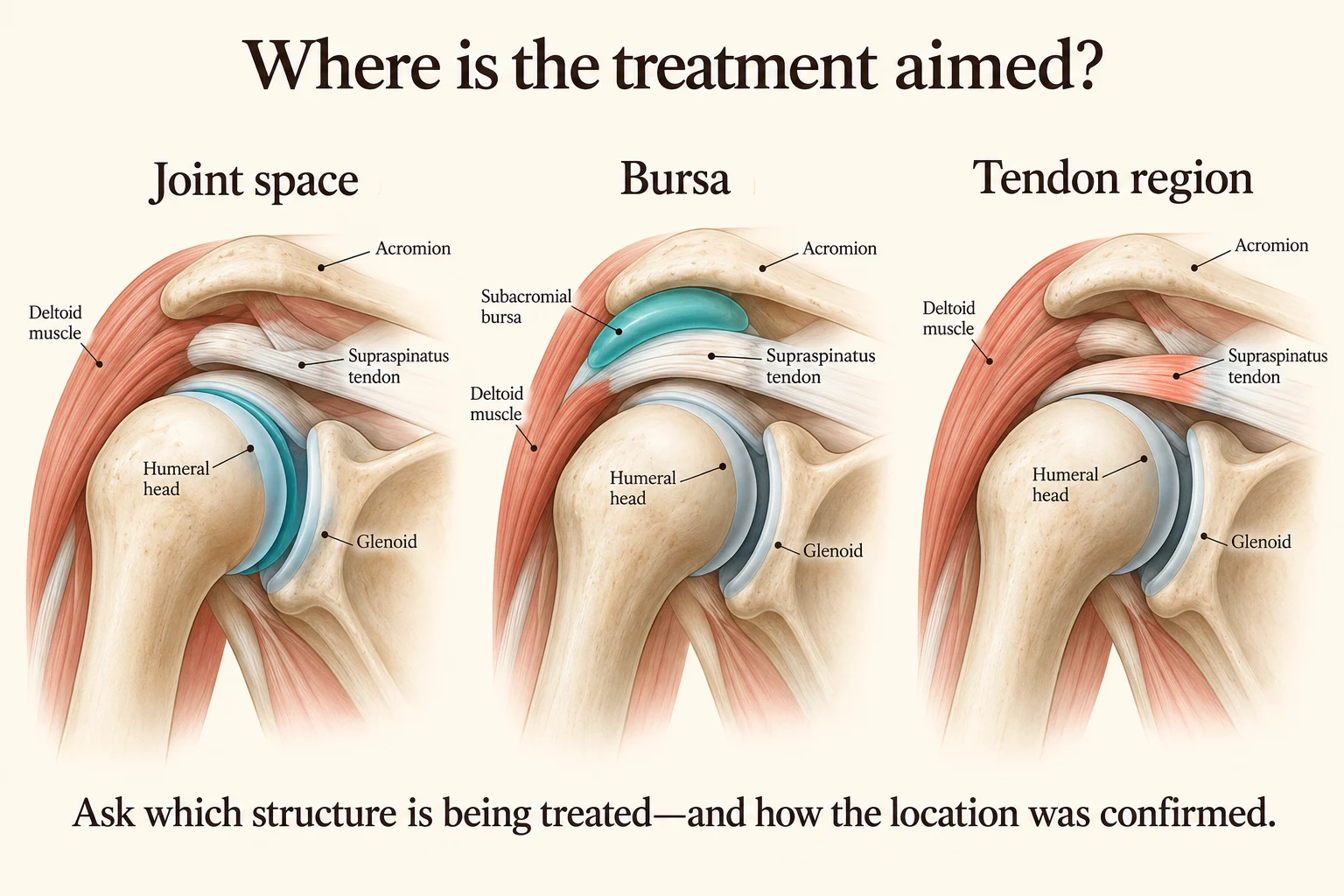
Original educational illustration. Shoulder schematics distinguish the joint space, subacromial bursa and tendon region.
A joint, bursa and tendon are different structures. Ask which structure is being treated and how its role in your symptoms was confirmed. The graphic does not suggest injecting medication into a tendon.
Illustration references: Reference 1 · Reference 2 · Reference 3
1. What structure are we treating?
Ask the clinician to name the target: a joint, a bursa, a tendon sheath or another structure. The location and diagnosis affect both the purpose and the risks. Pain near a shoulder or hip does not identify that target by itself. Ask what the examination and any imaging suggest, whether more than one structure could be involved, and why an injection would help answer the question. Keep the exact procedure name in your records so a future clinician does not have to guess what was injected.
Sources: Cortisone Shot: Benefits and FAQs
2. Is the goal treatment, diagnosis, or both?
An injection may contain a corticosteroid, local anesthetic, or a combination. Ask what each ingredient contributes and which part of your response the clinician wants you to report. Temporary numbing is different from a longer anti-inflammatory effect. If the injection is intended to make therapy or sleep more manageable, define that goal beforehand. A successful appointment should leave you knowing what useful change to look for, rather than simply waiting to see whether every symptom disappears.
Sources: Cortisone shots
3. Does the evidence fit this diagnosis?
For osteoarthritis, the September 2026 ACR summary strongly recommends hip and knee glucocorticoid injections, based on low-certainty evidence. That statement does not cover every tendon injury or explain the best choice for every patient. Ask how current guidance applies to your condition and how an injection compares with rehabilitation, medication or observation. A recommendation may still involve uncertainty about the size and duration of benefit. It should be explained in terms of your symptoms and the alternatives available.
Sources: 2026 ACR osteoarthritis recommendations: board-approved summary
4. Which risks need a personal plan?
Tell the team about diabetes, immune-suppressing medicines, skin problems, previous reactions and any infection or illness. Cortisone injections can temporarily raise blood glucose; people managing diabetes need individualized monitoring instructions. Other possible problems include a temporary pain flare, skin changes and infection. Ask which concerns are most relevant to the proposed site and your history, and who will help if they occur. Do not alter prescribed medicines on your own to prepare for an injection.
Sources: Cortisone shots
5. Would imaging guidance add something?
Some targets are deep or harder to locate reliably. Ask whether ultrasound or another imaging method is planned and what it adds for this injection. Guidance addresses placement; it does not establish that the medicine will solve the problem. If there is a separate imaging charge, understand it before treatment. You can also ask how the clinician confirms the intended side and site, especially when pain affects both limbs or you have had several different injections.
Sources: Cortisone Shot: Benefits and FAQs
6. How does this fit with earlier injections or surgery?
Bring previous injection dates, sites, products and the benefit you noticed. Repeating a procedure without reviewing that history can make it harder to judge whether the strategy is useful. Tell the clinician if an operation is being considered, even if no date has been chosen. The surgeon may have specific instructions about injection timing. Ask the clinicians to coordinate rather than trying to apply one universal waiting period across joints, tendon repairs and different operations.
Sources: Cortisone Shot: Benefits and FAQs
7. What should I do afterward?
Request the instructions before leaving: which activities to limit, how to manage discomfort, and when to resume your existing therapy plan. Ask which symptoms need a prompt call and which require urgent assessment. Increasing redness, fever or a markedly worsening painful joint should not be dismissed as a routine response without advice. Confirm the office's after-hours route, and arrange transport if the team recommends it. Your written instructions should match the exact procedure you received.
Sources: Cortisone shots
8. When will we decide whether it helped?
Choose a practical outcome to report, such as waking less often or completing a prescribed exercise session. Record when any change began and how long it lasted. If the injection does not help, ask whether that changes the suspected diagnosis or simply means this treatment was ineffective. We encourage a clear next conversation rather than an automatic series of injections. Know when follow-up is planned, what costs remain, and which alternative would be considered next.
Make a glucose plan before a steroid injection
A steroid injection can affect blood glucose, so tell the procedural clinician that you have diabetes before scheduling. Share the medicines you take, how you monitor glucose, and the clinician who manages your diabetes. Mention previous glucose changes after steroids if you have experienced them. Ask whether the proposed medicine and procedure are appropriate for your current situation and whether coordination with your diabetes team is needed first.
Request a specific monitoring and contact plan. Ask when to check, what readings or symptoms should prompt a call, and whom to contact outside office hours. The answer should fit your usual diabetes care and the proposed procedure; an online number or another patient's adjustment is not a substitute. Do not independently change insulin or another diabetes medicine because an injection is planned. Any temporary change should come from the clinician responsible for that part of your care.
If fasting, sedation, or a change in meals is involved, ask the two teams to reconcile those instructions with the medicine plan. Clarify what to do if the appointment is delayed, you cannot eat as expected, or you feel unwell. Tell the procedural team about a current infection or other new health concern before arrival. Keep the final instructions together so that a scheduling change does not leave you following an outdated plan.
At follow-up, report both symptom benefit and any disruption to glucose management. That information should influence future treatment decisions. If the injection offered little benefit but created substantial management difficulty, ask whether repeating it makes sense and what alternatives remain. A useful plan accounts for the whole experience, including the time and support needed to manage diabetes around the procedure.
Sources: Epidural Corticosteroid Injections · Epidural Injections · Preprocedural Recommendations for Reducing Surgical Site Infections
A hand or wrist injection needs a precise treatment target
A hand injection should begin with a clear explanation of the structure being treated. An injection around a tendon sheath, into an arthritic joint, and near a compressed nerve are different decisions. Ask the clinician to name the target and explain how the examination supports it. If more than one problem contributes to hand pain, clarify which symptom the injection is expected to help and which limitation may remain afterward.
Discuss the proposed medication and its purpose, including whether any immediate effect comes from a local anesthetic rather than the longer-term treatment. Ask how benefit will be judged and when the response should be reviewed. Bring details of previous injections, including the location, approximate date, and duration of any relief. Repeating a procedure should follow a reasoned reassessment rather than occur automatically because symptoms returned.
Risk depends on the site and your circumstances. Ask about skin or soft-tissue changes, infection, tendon concerns where relevant, and blood-sugar effects if you have diabetes. Tell the team about medicines, allergies, and previous reactions. Do not stop a prescribed medicine yourself to prepare. If ultrasound is proposed, ask what guidance adds for this target; a technology choice does not remove the need to assess the medication and the indication.
Before leaving, confirm aftercare, permitted hand use, and the contact route for a concerning reaction. Describe any task you cannot avoid, such as work tools or caregiving, so the instructions can be practical. Write down the task or symptom you will compare at follow-up. A clear plan should say what a worthwhile response looks like and what the clinician will reconsider if relief is limited or temporary.
Sources: Cortisone Shot (Steroid Injection) · Steroid Injections
What image guidance adds to an injection
Ultrasound can provide a real-time view of selected tissues and help a trained clinician localize an injection target. Landmark-based placement uses the examination and surface anatomy. The appropriate approach depends on the structure, the purpose of the injection, and the clinical circumstances. Ask what guidance adds for your particular joint, bursa, or other target. It is more useful to understand that reasoning than to assume that every injection needs the same technology.
The evidence is target-specific. The American College of Rheumatology’s September 2026 osteoarthritis guideline summary strongly supports ultrasound guidance for intra-articular corticosteroid injections in hip osteoarthritis, with low certainty of evidence. That recommendation should not be extended to every hand, tendon, or other injection. It also addresses placement, not a guarantee that the injected treatment will relieve symptoms or repair damaged tissue.
Ask the clinician to separate three questions: whether the selected structure explains the symptoms, whether the proposed medication has a worthwhile role, and how it will be placed. Accurate placement cannot compensate for an unsuitable treatment target. Discuss operator experience, the risks that remain, and any personal preparation needs. If another imaging method is proposed, ask why it fits the anatomy and what additional considerations apply. Do not change prescribed medicines without the treating team’s instructions.
Agree on what response to record and when it will be reviewed. A brief symptom change may answer a different question from a sustained improvement in a daily activity. If the injection is accurately placed but does not help, ask what the team will reassess rather than assuming that another guided injection must be the next step. This discussion supports an informed evaluation or referral; availability of a specific injection service should be confirmed with the clinician.
Sources: Musculoskeletal Ultrasound · Cortisone Shot (Steroid Injection) · 2026 ACR osteoarthritis recommendations: board-approved summary
Make the most of your visit
Questions to bring to your consultation
Choose the questions that matter most to you. Bring them along, and ask us to explain anything that is unclear.
- What exactly will be injected, and into which structure?
- What response would support the suspected diagnosis?
- What benefit is realistic for my specific condition?
- How should my diabetes or medicines affect preparation?
- Would imaging guidance help with this target?
- Does a possible operation change the timing?
- Which symptoms after the injection require a call?
- When should we reassess if it does not help?
- How should this steroid injection change my glucose monitoring and contact plan?
- Who will provide any temporary diabetes-medicine adjustment if one is needed?
- How will the benefit and glucose effects influence whether we repeat treatment?
- Which structure and symptom are we targeting?
- What personal and location-specific risks should I understand?
- How and when will we decide whether the injection was worthwhile?
- What does ultrasound add for my specific target?
- How do you separate placement accuracy from evidence for the treatment itself?
- If symptoms do not improve, what will we reassess?
Sources & further reading
- Cortisone Shot: Benefits and FAQsHospital for Special Surgery
- Cortisone shotsMayo Clinic
- 2026 ACR osteoarthritis recommendations: board-approved summaryAmerican College of Rheumatology
- Epidural Corticosteroid InjectionsJohns Hopkins Medicine
- Epidural InjectionsACR / RSNA RadiologyInfo
- Preprocedural Recommendations for Reducing Surgical Site InfectionsASRA Pain Medicine
- Cortisone Shot (Steroid Injection)American Academy of Orthopaedic Surgeons (AAOS OrthoInfo)
- Steroid InjectionsAmerican Society for Surgery of the Hand (ASSH / The Hand Society)
- Musculoskeletal UltrasoundHospital for Special Surgery
We use these medical sources to help explain your options and prepare you for a conversation with our team. Our guides feature our own clinicians; patient reviews describe individual experiences.