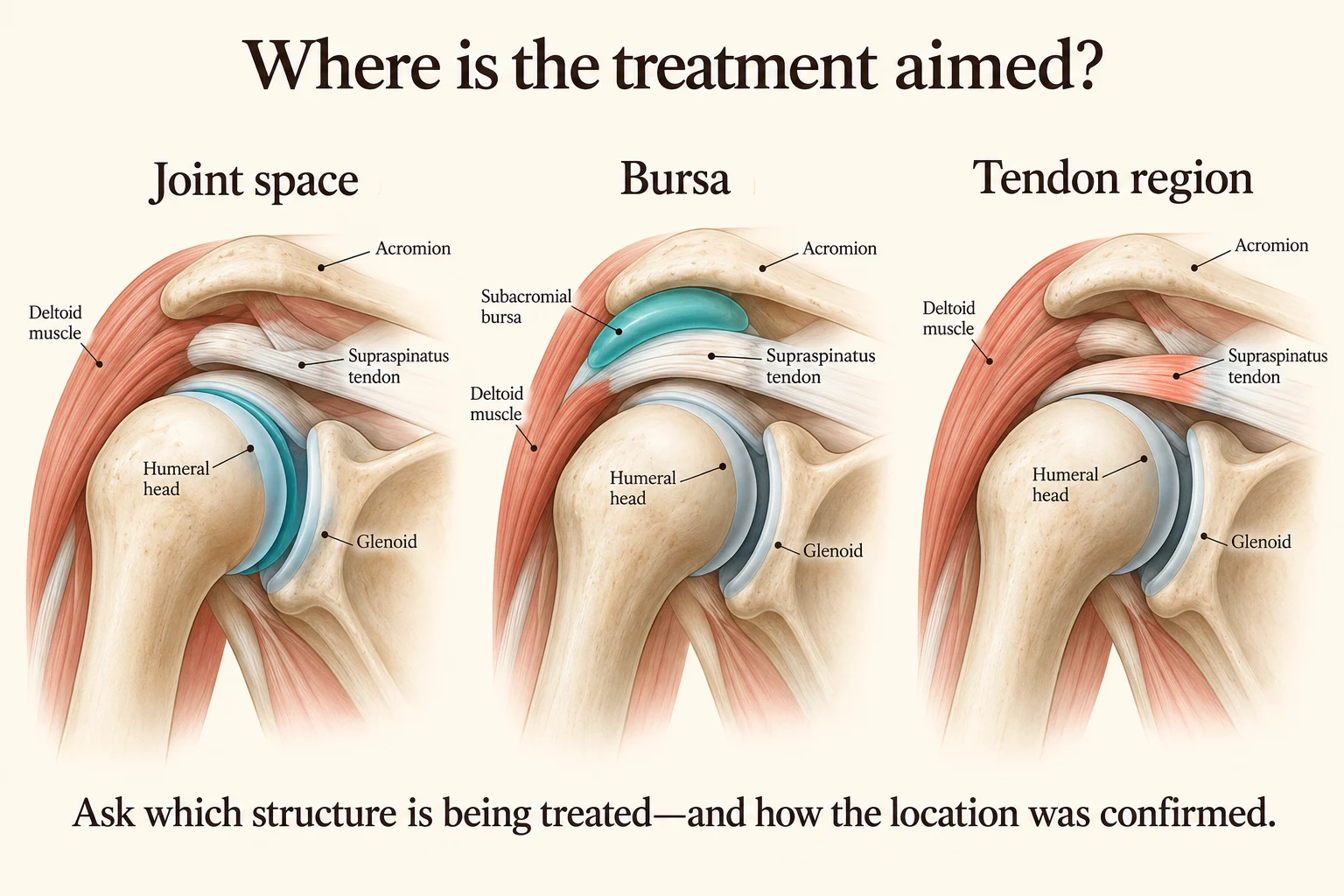
Original educational illustration. Shoulder schematics distinguish the joint space, subacromial bursa and tendon region.
A joint, bursa and tendon are different structures. Ask which structure is being treated and how its role in your symptoms was confirmed. The graphic does not suggest injecting medication into a tendon.
Illustration references: Reference 1 · Reference 2 · Reference 3
1. Does the deposit explain the symptoms?
Ask where the deposit is and how the examination connects it with your pain and movement limits. Other shoulder conditions can coexist, including tendon tears or stiffness. The size of a finding on an image is not a complete measure of how much it affects you. Describe whether symptoms began suddenly, fluctuate or have persisted despite treatment. A clear diagnosis should explain what is known, what remains uncertain and why the proposed treatment targets the problem you are experiencing.
Sources: Calcific Tendonitis
2. What should a nonsurgical plan accomplish?
Discuss symptom management, appropriate activity adjustments and rehabilitation before assuming a procedure is necessary. Ask what the program will target and how it will be adapted if pain makes participation difficult. Medicines need review against your health and other prescriptions. Choose a few meaningful goals, such as improved sleep or easier dressing, and agree on a reassessment point. The aim is an active plan with a purpose, rather than indefinite waiting or repeated treatment without checking whether it is helping.
Sources: Calcific Tendonitis
3. What does the evidence say about lavage?
Ultrasound-guided lavage attempts to wash material from a deposit. A 2023 sham-controlled trial in 220 adults with persistent calcific shoulder tendinopathy found no meaningful advantage of lavage plus steroid over sham treatment at its primary four-month assessment; later results also did not show superiority. That trial challenges the idea that deposit removal reliably improves symptoms. Ask how the clinician interprets it for your situation and whether a proposed technique differs in a way supported by evidence, rather than assuming that seeing calcium removed proves clinical benefit.
Sources: Ultrasound guided lavage for calcific shoulder tendinopathy: sham-controlled randomized trial
4. How uncertain is shockwave treatment?
Shockwave therapy is another option that may be discussed. NICE's 2022 guidance found inadequate evidence of efficacy for calcific shoulder tendinopathy and recommended use in a research context. That is UK procedural guidance, and it should be considered alongside the evidence and standards relevant to your care. Ask which device, treatment course and outcomes are being proposed, what they cost and how improvement would be judged. A treatment described as noninvasive still deserves a clear discussion of uncertainty and alternatives.
If you are offered a package of sessions, ask what happens if symptoms worsen or there is no meaningful improvement partway through. Clarify whether the course can be reassessed and whether the payment arrangement pressures you to continue. A plan should allow clinical review of the response, rather than treating the number of prepaid appointments as the reason for completing treatment.
Sources: Extracorporeal shockwave therapy for calcific tendinopathy in the shoulder
5. When would surgery be a reasonable discussion?
If symptoms remain limiting, ask what findings would justify an operation and what it would involve. Removing a deposit, addressing associated tissue and repairing a tendon are different commitments. Ask whether the plan might change after direct inspection and how those possibilities affect consent and rehabilitation. A procedure should be chosen for a clinical reason, not simply because the deposit remains visible. Discuss the chance of persistent symptoms and what other explanation would be reconsidered if the expected improvement does not occur.
Sources: Calcific Tendonitis
6. What will guide the next decision?
Track the activities and symptoms the team asks you to follow, including how the plan affects sleep, reach and work. Bring the dates and response to earlier injections or procedures. Ask which result would support continuing, changing direction or seeking another opinion. Our shoulder clinicians can help evaluate the problem and explain appropriate options; confirm any specific procedure directly. Patient experiences may speak to support during care, but they cannot establish that a disputed procedure works. The next step should follow your clinical findings and an honest discussion of the evidence. Record whether improvement changes function as well as pain.
Sources: Ultrasound guided lavage for calcific shoulder tendinopathy: sham-controlled randomized trial
Make the most of your visit
Questions to bring to your consultation
Choose the questions that matter most to you. Bring them along, and ask us to explain anything that is unclear.
- Does the calcium deposit explain my symptoms?
- What else could be causing pain or stiffness?
- What should a nonsurgical trial improve?
- How do you interpret the sham-controlled lavage trial?
- What supports shockwave therapy for my circumstances?
- When would surgery be justified, and what might it involve?
- How will we decide whether to continue or change treatment?
Sources & further reading
- Calcific TendonitisCleveland Clinic · Published August 12, 2021
- Ultrasound guided lavage for calcific shoulder tendinopathy: sham-controlled randomized trialThe BMJ · Published October 11, 2023
- Extracorporeal shockwave therapy for calcific tendinopathy in the shoulderNational Institute for Health and Care Excellence · Published November 30, 2022
We use these medical sources to help explain your options and prepare you for a conversation with our team. Our guides feature our own clinicians; patient reviews describe individual experiences.